
Group L — England, Croatia, Ghana & Serbia
 Available in US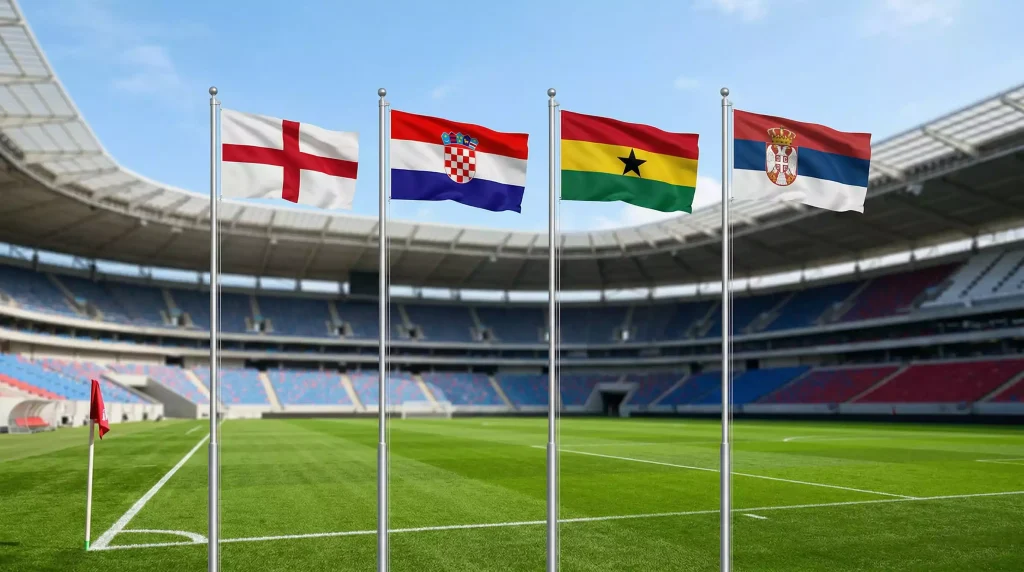
Table of Contents
Walk into any pub in Dublin, Cork, or Galway on a Premier League Saturday and count the England shirts. You will find Liverpool red, Arsenal red, Manchester United red in various shades — English club football woven so deeply into Irish sporting culture that national team boundaries blur. Irish football fans know English players intimately: their strengths, weaknesses, career arcs, and big-match temperament. When England play at World Cup 2026, millions of Irish viewers will watch with complicated emotions — not quite support, certainly not opposition, something in between that reflects centuries of intertwined history. Group L matters to Irish audiences because England matters, whether we like it or not.
England — Perennial Promise
English football has produced outstanding individual talent for decades without converting that talent into World Cup success since 1966 — a drought lasting fifty-eight years by the time the 2026 tournament begins. The pattern repeats: exceptional squads generate justified expectations, tournament draws appear favourable, and then something goes wrong. Penalty shootouts, tactical rigidity, individual errors, or simply superior opponents — excuses vary while disappointment remains constant. This England generation carries the burden of every previous failure while claiming qualification as the strongest squad in modern history.
The current England squad would start multiple players at any club in world football. Harry Kane has proven himself among history’s great goalscorers, his movement and finishing clinical at the highest levels. Jude Bellingham emerged as the world’s most complete midfielder, his dynamism combining technical excellence with physical presence that opponents cannot contain. Phil Foden provides creative genius from deeper positions. Bukayo Saka threatens from wide areas with pace and directness. The supporting cast includes players who would headline most international squads — England’s depth approaches Brazil 2002 or France 2018 levels.
Group L presents challenges that England must overcome to justify championship expectations. Croatia possess the tournament experience and technical quality to create difficulties regardless of English advantages elsewhere. Serbia’s physicality and Ghana’s pace test defensive organisation that previous tournaments have exposed. England should qualify — that outcome approaches certainty given quality differentials — but group stage performances will indicate whether 2026 represents genuine breakthrough opportunity or another edition of promise unfulfilled.
England to win Group L at odds around 4/9 (1.44 decimal) offers minimal value despite high probability. More interesting angles include England over 2.5 goals against Ghana at approximately 4/7 (1.57 decimal), or England to win to nil against Serbia at around 5/4 (2.25 decimal). England versus Croatia under 2.5 goals at 11/10 (2.10 decimal) reflects the tactical chess these teams produce when meeting at major tournaments. For tournament believers, England outright around 9/2 (5.50 decimal) provides reasonable entry for those convinced this generation breaks the drought.
Croatia — Knockout Round Specialists
Croatian World Cup performance defies statistical probability. A nation of four million people has reached two of the last three World Cup finals (2018, runner-up; 2022, third place), consistently competing against populations ten times larger. Their secret combines exceptional midfield quality with tournament mentality that elevates performance when stakes matter most. Luka Modrić anchored this success, but Croatian football development has produced replacements who maintain competitive standards as golden generation players age out.
Modrić at the 2026 World Cup will be 40 years old — a farewell tour for one of football’s most elegant midfielders. His influence has diminished from peak levels but remains significant, particularly in controlling possession and dictating tempo during knockout round pressure. The transition to post-Modrić Croatia has begun: younger midfielders have integrated, tactical systems have evolved, and Croatian football identity now extends beyond one extraordinary individual. Whether this evolution maintains knockout round consistency remains the central question of their 2026 campaign.
Group L positions Croatia as England’s primary challenger for group leadership. Their technical midfield quality troubles English systems that sometimes lack comparable control. Ghana and Serbia represent winnable fixtures where Croatian experience should prove decisive. Second place at minimum appears achievable, with group victory possible if England underperform or Croatia exceed already impressive standards. Modrić’s final tournament provides emotional motivation that supplements considerable technical ability.
Croatia to qualify from Group L at odds around 4/9 (1.44 decimal) represents near-certainty without exciting returns. More interesting value appears in Croatia versus England draw at 11/4 (3.75 decimal) — reflecting historical patterns where these teams neutralise each other. Croatia to finish second at approximately 5/4 (2.25 decimal) provides more specific value for those confident in their consistency behind English favouritism. I view Croatia as reliable knockout qualifiers whose tournament experience exceeds market respect.
Ghana — African Revival
Ghana’s 2010 World Cup quarter-final remains African football’s most agonising memory. Luis Suárez’s deliberate handball on the line, Asamoah Gyan’s missed penalty that would have sent Ghana to semi-finals, and Uruguay’s subsequent shootout victory combined into heartbreak that haunts Ghanaian football. That generation promised African breakthrough that never materialised; subsequent tournaments have seen Ghana struggle to recapture 2010 levels. The 2026 World Cup represents opportunity for new generation to rewrite that narrative with happier conclusion.
The current Ghanaian squad features several players competing at elite European levels. Mohammed Kudus provides attacking dynamism from West Ham, his dribbling and shooting creating individual threat that compensates for collective limitations. Thomas Partey anchors midfield with Arsenal-level discipline and distribution. These individuals provide quality that World Cup opponents must respect, even when supporting cast depth raises questions about consistency across three demanding group fixtures.
Group L challenges Ghana with opposition whose quality should prove overwhelming. England and Croatia possess advantages in technical, tactical, and experiential dimensions that Ghanaian resources cannot fully match. Serbia represent more direct competition — a fixture that likely determines third-place positioning and advancement possibilities among best third-placed teams. Ghana’s ceiling involves competitive performances that suggest African football progress; their floor involves three defeats that highlight development still required.
Ghana to qualify from Group L at odds around 7/2 (4.50 decimal) represents speculative value for believers in individual brilliance overcoming collective limitations. More realistic angles include Ghana to score against England at approximately 4/5 (1.80 decimal), reflecting Kudus’s capability against any defence. Ghana versus Serbia draw at around 11/4 (3.75 decimal) suits both teams’ mutual caution in circumstances where points matter desperately. I view Ghana as capable of upset moments without sustained group campaign success.
Serbia — Balkan Talent Factory
Serbian football has produced remarkable individual talent relative to population size: Dejan Stanković, Nemanja Vidić, Branislav Ivanović, and now Dušan Vlahović and Aleksandar Mitrović carry attacking threat that troubles elite defences. What Serbian football has not produced is tournament success — their World Cup record shows group stage exits and occasional qualification failures that underutilise the quality their development pathways generate. The pattern suggests collective limitations that individual brilliance cannot overcome at football’s highest levels.
The current Serbian squad features multiple players competing at elite European club levels. Vlahović leads Juventus attack with finishing quality that approaches world-class standards. Mitrović provides physical presence and goal threat from Premier League experience. The midfield includes creative and defensive options that any manager would value. Serbia’s squad depth approaches tournament contender levels — the question involves whether organisation and mentality can maximise resources that raw talent assessment suggests should perform better.
Group L positions Serbia as underdogs against European elite and African ambition. England and Croatia should prove too strong regardless of Serbian effort. Ghana represent direct competition for advancement possibilities — the fixture most likely to produce Serbian points. Third place with competitive performances constitutes realistic expectation; second place would require Croatian regression that their tournament pedigree makes improbable. Serbian talent deserves knockout football, but group draw suggests another early exit.
Serbia to qualify from Group L at odds around 5/1 (6.00 decimal) offers marginal value for those believing in talent over tournament history. More realistic angles include Serbia to beat Ghana at approximately 11/8 (2.38 decimal), a fixture where Serbian quality advantage should prove decisive. Serbia to score against England at around 4/5 (1.80 decimal) reflects attacking capability that troubles any defence through set pieces and Mitrović’s aerial presence. I would target specific Serbian outcomes rather than outright qualification.
Why Irish Fans Care About England
The relationship between Irish football fans and the English national team defies simple categorisation. History, colonialism, and sporting rivalry create undertones that complicate straightforward support. Yet practical reality overrides theoretical objection: Irish people watch more Premier League football than any other league, support English clubs with genuine passion, and know English players through weekly exposure that domestic leagues cannot match. When England play World Cup matches, Irish audiences watch in numbers that exceed most other nations.
Premier League penetration in Irish life explains much of this dynamic. Liverpool, Manchester United, Arsenal, Chelsea, and increasingly Manchester City maintain enormous Irish supporter bases. Irish children grow up watching English football, wearing English club shirts, following English players’ careers with intimate familiarity. The English national team represents these players in different colours — supporting England becomes natural extension of club loyalty rather than betrayal of national identity. Context matters more than flags.
For Irish punters specifically, England betting represents informed wagering rather than patriotic speculation. We know these players: their big-match temperament, their injury histories, their tactical roles within club and national systems. This knowledge creates analytical edge that casual observers cannot match. When assessing England versus Croatia, Irish bettors bring contextual understanding from hundreds of Premier League matches that shapes probability assessment. Group L offers opportunity to monetise familiarity that stems from cultural proximity we did not choose but cannot ignore.
Fixtures & Kick-Off Times (IST)
Group L scheduling provides accessible viewing windows for Irish audiences with particular interest in English progress. Most fixtures fall during evening hours that permit comfortable viewing after work or social activities. The England versus Croatia headliner receives prime positioning that acknowledges its significance for group standings and neutral entertainment value. Distributed kick-off times ensure complete group coverage for those following all four teams.
| Date | Match | Kick-Off (IST) | Venue |
|---|---|---|---|
| 19 June 2026 | England vs Serbia | 20:00 | TBC |
| 19 June 2026 | Croatia vs Ghana | 17:00 | TBC |
| 24 June 2026 | England vs Croatia | 20:00 | TBC |
| 24 June 2026 | Ghana vs Serbia | 17:00 | TBC |
| 28 June 2026 | England vs Ghana | 23:00 | TBC |
| 28 June 2026 | Croatia vs Serbia | 23:00 | TBC |
Opening fixtures establish immediate group context for Irish audiences. England versus Serbia at 20:00 IST offers comfortable evening viewing — the first opportunity to assess English tournament readiness. Croatia versus Ghana at 17:00 IST provides earlier context for those tracking complete group dynamics. Both favourites should win, setting up England versus Croatia as the decisive fixture for group leadership. Opening day results will likely confirm pre-tournament expectations without dramatic surprise.
Matchday two delivers the group’s main event. England versus Croatia at 20:00 IST recreates their 2018 World Cup semi-final rematch — a fixture heavy with historical significance for both nations. English revenge for that devastating defeat or Croatian confirmation of continued tournament excellence become the narrative possibilities. Simultaneous Ghana versus Serbia at 17:00 IST determines which unfancied team claims third-place advantage, potentially becoming decisive for expanded qualification pathways.
Final matchday fixtures at 23:00 IST require later viewing but should confirm rather than transform group standings. England versus Ghana tests English quality against African pace in circumstances where rotation might occur if group position is secure. Croatia versus Serbia becomes Balkan derby with third-place implications if Croatian qualification is not already confirmed. By this stage, knockout scenarios should be largely determined, with final matches providing closure rather than transformation.
Predictions & Odds
Group L hierarchy should favour English quality over Croatian experience, with Ghana and Serbia contesting third place below both European powers. England possess the squad depth and individual quality to dominate all three fixtures, though Croatian tournament pedigree creates genuine competition for group leadership. The draw determines which team faces potentially more difficult knockout pathways — a consideration that both teams will weight appropriately in their direct encounter.
My predicted final standings: England first with seven points, defeating Ghana and Serbia while drawing against Croatian quality that demands respect. Croatia second with seven points on goal difference, matching English results but finishing behind due to head-to-head dynamics or lesser goal margin against weaker opponents. Ghana third with three points, defeating Serbia through individual moments of brilliance. Serbia fourth with zero points, outclassed throughout despite individual quality that deserved better collective result.
| Team | To Win Group | To Qualify (Top 2) | To Finish 3rd |
|---|---|---|---|
| England | 4/9 (1.44) | 1/7 (1.14) | 12/1 (13.00) |
| Croatia | 9/4 (3.25) | 4/9 (1.44) | 4/1 (5.00) |
| Ghana | 12/1 (13.00) | 7/2 (4.50) | 11/10 (2.10) |
| Serbia | 14/1 (15.00) | 5/1 (6.00) | 5/4 (2.25) |
Croatia to win Group L at 9/4 (3.25 decimal) represents my primary value selection. Their tournament pedigree, midfield control, and ability to raise performance levels against elite opposition create genuine group winner potential that English inconsistency at major tournaments does not preclude. I view Croatia as underpriced relative to their capability against England specifically.
England versus Croatia draw at 11/4 (3.75 decimal) provides strong value for the group’s decisive fixture. Historical patterns suggest mutual respect and tactical caution when these teams meet at major tournaments. Under 2.5 goals in that fixture at around 11/10 (2.10 decimal) reinforces the expectation of tight, controlled contest. England match markets against Ghana and Serbia offer more reliable value than group positions where Croatian competitiveness creates uncertainty.
For comprehensive tournament analysis and knockout pathway implications from Group L, the World Cup 2026 groups hub provides broader context that informs strategic betting across all twelve groups.
