
Group F — Netherlands, Japan, Tunisia & Sweden
 Available in US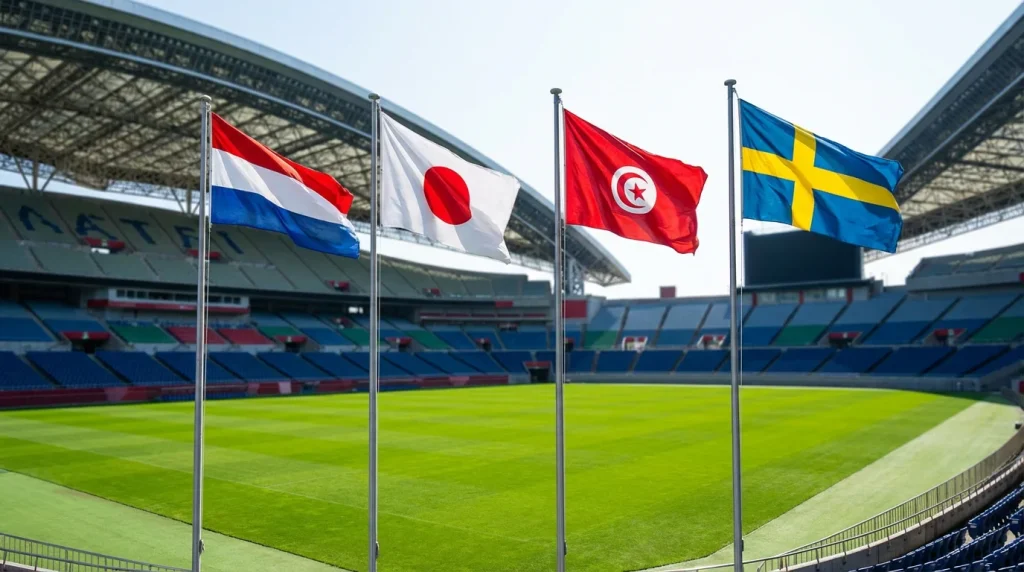
Table of Contents
Japan’s 2022 World Cup campaign should have changed how we understand Asian football permanently. Victories over Germany and Spain — actual victories, not fluked draws or fortunate circumstances — demonstrated that Japanese tactical sophistication had reached European elite levels. Yet here we are, examining Group F odds that still price Japan as outsiders behind the Netherlands, as if those results were aberrations rather than evidence. This group promises exceptional football: Dutch total football philosophy meeting Japanese precision, Swedish physicality challenging Tunisian technique, and four nations each genuinely capable of knockout qualification.
Netherlands — Three Finals, Seeking First Title
The Dutch have lost three World Cup finals — 1974, 1978, and 2010 — making them the most successful nation never to lift the trophy. Each defeat carried particular anguish: Johan Cruyff’s total football undone by host nation advantage in 1974, the repeat failure four years later, and then Iniesta’s extra-time winner crushing a generation that included Robben, Sneijder, and van Persie. This history weighs on Dutch World Cup campaigns in ways that statistical analysis cannot capture. Every tournament becomes an opportunity for redemption, and every early exit compounds the psychological burden.
The current Netherlands squad has undergone significant transition since their 2022 quarter-final run. The established stars are entering their final international tournaments, while younger players have integrated into systems that balance traditional Dutch attacking philosophy with modern defensive pragmatism. What has not changed is the technical foundation — Dutch players receive among the world’s finest youth development, producing technically excellent footballers regardless of position. This quality should translate into group stage dominance against opponents who lack comparable resources.
Group F appears manageable on paper. The Netherlands should defeat Tunisia and Sweden comfortably, leaving the Japan fixture as the only genuine concern. That match will likely determine group winners, and Japanese ability to expose Dutch defensive vulnerabilities creates uncertainty that odds around 4/7 (1.57 decimal) for group victory do not adequately reflect. I rate Japan as genuine contenders to top this group, making the Netherlands’ favouritism less convincing than markets suggest.
Betting on Netherlands to win Group F offers minimal value at current prices. More interesting angles include Netherlands over 2.5 goals against Tunisia or Sweden at around 4/5 (1.80 decimal), or total group goals over 6.5 at similar prices. The attacking quality should produce comfortable victories against the group’s weaker teams. Against Japan, Dutch defensive vulnerabilities create opportunities for those seeking to bet against favouritism.
Japan — Giant-Killers Return
Before Japan’s 2022 World Cup campaign, I had never seen an Asian team consistently outplay European giants. Not survive through defensive heroics or fortunate circumstances, but genuinely dominate through tactical superiority and technical execution. Japan’s victories over Germany and Spain represented watershed moments — proof that geographical boundaries no longer determine footballing quality. The European coaches who dismissed Asian football as inferior were forced to reassess assumptions decades in the making.
What makes Japan particularly dangerous is their combination of collective discipline and individual brilliance. Players like Mitoma, Kubo, and Doan compete at European football’s highest levels, bringing the intensity and quality of Champions League football to national team duty. The supporting cast provides the organisation that allows these individuals to express themselves, pressing with an intensity that exhausts technically superior opponents. Japan do not win through luck or opponent error — they win through being better for decisive periods.
Group F represents an opportunity for Japan to confirm their 2022 performances were beginnings rather than peaks. Defeating the Netherlands would announce their arrival as genuine World Cup contenders. Comfortable victories over Tunisia and Sweden would demonstrate consistency. Anything less than knockout qualification would feel like regression, given what they achieved four years ago. The pressure cuts differently for Japan — they carry not disappointment but expectation.
Japan to win Group F at odds around 5/2 (3.50 decimal) represents my strongest conviction in Group F betting. Their 2022 performances proved capability that odds have not yet fully absorbed. The Netherlands represent beatable opposition, particularly if Dutch complacency emerges in the manner that German and Spanish complacency did in 2022. For more conservative bettors, Japan to qualify at around 4/9 (1.44 decimal) offers certainty without excessive risk.
Tunisia — African Hopefuls
Tunisian football carries the burden of representing not just their nation but an entire continent’s hopes. African teams have historically struggled at World Cups, with only three nations — Cameroon 1990, Senegal 2002, Ghana 2010, and Morocco 2022 — reaching the quarter-finals or beyond. Tunisia have participated in six World Cups without ever progressing beyond the group stage, a record that demands improvement in 2026. Whether this squad possesses the quality to break that pattern remains the central question of their campaign.
The current Tunisian squad features several players competing at respectable European levels, though none approach superstar status. What Tunisia provide is collective organisation refined through competitive African qualification and continental championship experience. They know how to frustrate technically superior opponents, how to make matches ugly when aesthetic football would favour the opposition. This pragmatism serves them well against European teams expecting open contests but struggles against opponents equally committed to defensive discipline.
Group F presents Tunisia with significant challenges. The Netherlands and Japan both possess quality that should overwhelm Tunisian defensive organisation over ninety minutes. Sweden represent the most realistic opportunity for points, a fixture where Tunisian tactical discipline might neutralise Swedish directness. The pathway to qualification likely requires victory against Sweden, competitive performances against the stronger opponents, and favourable goal difference among third-placed teams.
Tunisia to qualify from Group F at odds around 7/2 (4.50 decimal) offers poor value given the opposition quality. Their ceiling in this group is third place with perhaps four points, which might be sufficient for Round of 32 progression but requires favourable cross-group comparisons. More interesting are specific match markets — Tunisia versus Sweden draw at around 11/4 (3.75 decimal) reflects both teams’ tendency toward cagey tournament football.
Sweden — Nordic Resilience
Swedish football operates on principles of collective efficiency rather than individual brilliance. The generation of Zlatan Ibrahimović has passed, leaving a squad that compensates through organisation, physical presence, and relentless work rate. This approach produces consistent results against comparable opposition while struggling against technically superior teams that can bypass Swedish pressing. At World Cups, Sweden typically survive the group stage before falling to genuine contenders in knockout rounds — a pattern established in 2018 when they reached the quarter-finals before losing to England.
The current Swedish squad lacks the attacking star power that previous generations possessed. What remains is defensive solidity and set-piece threat — Sweden convert a higher percentage of corners and free kicks than almost any European nation, their height advantages throughout the squad creating aerial dominance that shorter opponents cannot match. Against Tunisia, this physical superiority should prove decisive. Against Japan and Netherlands, it might prove insufficient. The Swedish approach works best when opponents play into their hands, attempting to match physicality rather than circumvent it with movement and technique.
Sweden’s qualification campaign revealed both strengths and limitations in equal measure. Victories against direct opponents demonstrated their competitive spirit, while defeats to technically superior teams exposed the quality ceiling that exists without elite individual talent. Manager strategy emphasises pragmatism over ambition — Sweden accept what they are and maximise those qualities rather than pretending to be something more. This honesty of approach earns respect without inspiring confidence in knockout round potential.
Group F positions Sweden as underdogs for qualification. Their path requires defeating Tunisia while stealing points from either Japan or Netherlands — a combination that seems unlikely given the quality differential. The more realistic scenario sees Sweden finish third or fourth, their competitive efforts insufficient against technically superior opponents. For a nation that reached the 2018 quarter-finals, this would represent regression, but World Cup football has become increasingly competitive.
Sweden to qualify from Group F at odds around 3/1 (4.00 decimal) represents speculative value for those believing in their tournament pedigree. The more conservative approach targets Sweden to beat Tunisia at around 5/4 (2.25 decimal), a fixture where Swedish physical advantages should prove decisive. Against Japan and Netherlands, I would consider Asian handicap markets that allow for competitive defeats rather than backing Swedish victories.
Fixtures & Kick-Off Times (IST)
Group F scheduling creates accessible viewing windows for Irish audiences, with most kickoffs during evening hours rather than the early morning slots that characterise groups heavily concentrated in North American time zones. The headlining Netherlands versus Japan fixture receives prime positioning, ensuring maximum television audiences for what could prove the group’s most entertaining match.
| Date | Match | Kick-Off (IST) | Venue |
|---|---|---|---|
| 15 June 2026 | Netherlands vs Sweden | 20:00 | TBC |
| 15 June 2026 | Japan vs Tunisia | 17:00 | TBC |
| 20 June 2026 | Netherlands vs Japan | 20:00 | TBC |
| 20 June 2026 | Sweden vs Tunisia | 17:00 | TBC |
| 24 June 2026 | Netherlands vs Tunisia | 23:00 | TBC |
| 24 June 2026 | Japan vs Sweden | 23:00 | TBC |
Opening day brings Netherlands versus Sweden at 20:00 IST — comfortable viewing for Irish audiences expecting Dutch dominance against organised Swedish resistance. The earlier Japan versus Tunisia at 17:00 IST provides afternoon entertainment for those following the full group picture. These fixtures should clarify hierarchies immediately, with Netherlands and Japan expected to establish dominance.
The crucial matchday two fixture between Netherlands and Japan at 20:00 IST represents the group’s main event. This match likely determines which team tops the group, with knockout round draw implications that make the result significant beyond mere points accumulation. The simultaneous Sweden versus Tunisia at 17:00 IST determines which team claims third place, making it essential viewing for those tracking expanded qualification pathways.
Final matchday kickoffs at 23:00 IST require slightly later viewing but remain accessible for most Irish audiences. Netherlands versus Tunisia should be completed business for the Dutch, potentially prompting squad rotation. Japan versus Sweden becomes decisive for qualifying positions, with Japanese quality expected to overcome Swedish physical challenge.
Predictions & Betting Odds
Group F’s competitive balance makes predictions genuinely uncertain. The Netherlands should qualify but might not top the group. Japan have proven capable of defeating European elite opposition, making their second favourite status potentially undervalued. Tunisia and Sweden will battle for third place, with both capable of springing individual match upsets without sustaining qualification across three fixtures.
My predicted final standings: Japan first with seven points, defeating Tunisia and Sweden while drawing with Netherlands in a tactically fascinating encounter. Netherlands second with six points, beating Tunisia and Sweden but unable to break Japanese organisation. Sweden third with three points, defeating Tunisia but falling to both fancied opponents. Tunisia fourth with one point, their draw against Sweden insufficient for advancement.
| Team | To Win Group | To Qualify (Top 2) | To Finish 3rd |
|---|---|---|---|
| Netherlands | 4/7 (1.57) | 1/7 (1.14) | 8/1 (9.00) |
| Japan | 5/2 (3.50) | 4/9 (1.44) | 5/1 (6.00) |
| Tunisia | 12/1 (13.00) | 7/2 (4.50) | 11/8 (2.38) |
| Sweden | 11/1 (12.00) | 3/1 (4.00) | 11/8 (2.38) |
Japan to win Group F at 5/2 (3.50 decimal) represents my strongest value conviction in this group. Their 2022 performances demonstrated capability that odds have not fully absorbed. The Netherlands’ historical World Cup struggles create doubt that their status as favourites does not account for. I consider Japan genuine value at current prices.
Netherlands versus Japan offers the most interesting match betting. Draw at around 11/4 (3.75 decimal) reflects both teams’ potential to neutralise each other, while Japan on double chance at around 10/11 (1.91 decimal) provides insurance against Dutch superiority. Under 2.5 goals in this fixture at around 6/5 (2.20 decimal) suits the tactical sophistication both teams will bring.
For detailed analysis of how Group F fits into the broader World Cup 2026 group stage picture, including knockout round pathways and cross-group comparisons, our comprehensive hub provides the context serious bettors require.
