
World Cup 2026 Groups — Draw, Fixtures & Predictions
 Available in US
Table of Contents
Twelve groups. Forty-eight teams. Sixty-four matches across eighteen days. The 2026 World Cup group stage is the largest in tournament history, and the complexity creates opportunities that did not exist at previous editions. Understanding how the groups are constructed — which teams have favourable draws, which face early elimination battles, and where the value sits — is the foundation of smart tournament betting.
The draw took place in December 2025, and the resulting composition sparked immediate analysis. Some groups fell kindly for favourites; others clustered competitive sides into early-stage battlegrounds. I have spent months mapping the permutations, and this guide presents my assessment of all twelve groups, predictions for qualification, and the fixtures that demand attention. For Irish punters, Group C (Scotland) and Group L (England) carry emotional weight, and I address both in detail.
The format rewards aggression. Top two in each group advance automatically to the round of thirty-two. The eight best third-placed teams also progress — a new pathway that changes strategic calculations. A team sitting on four points after three matches is no longer dead; they might squeeze through as one of the fortunate eight. This possibility alters how I price group-stage bets: the difference between finishing second and third is narrower than at previous World Cups, which affects match betting, over/under goals, and tactical approaches in final group games.
Group Stage Format — How Qualification Works
Before diving into individual groups, understanding the qualification mechanics is essential. This is not the thirty-two-team format we have grown accustomed to; the expansion changes everything about how groups function and how betting angles develop.
Each group contains four teams, just as before. Each team plays three matches — one against each group rival — accumulating points on the standard system: three for a win, one for a draw, zero for a loss. The two teams with the most points advance to the round of thirty-two. So far, familiar territory.
The innovation is the third-place pathway. Across twelve groups, twenty-four third-placed teams exist. Eight of them — the best eight, ranked by points, goal difference, and goals scored — also advance. This means two-thirds of third-placed finishers progress, fundamentally changing the risk calculus for teams and bettors alike.
What does “best third-placed team” look like? Historical modelling from previous tournaments with similar pathways (Euro 2016 and Euro 2020/21 both used this system with six groups) suggests four points guarantees progression; three points with a positive goal difference makes the cut in most scenarios; three points with a negative goal difference is borderline and requires favourable results elsewhere. A third-placed team with two points — one draw, two losses — almost certainly goes home, but even that is not guaranteed if other groups produce chaotic results. One point is nearly always elimination.
This pathway creates perverse incentives that sharp bettors can exploit. A team that has lost its opening match but won its second is not eliminated; it can play for the draw in match three to secure third place with four points. That incentive reduces late group-stage drama — fewer all-or-nothing final fixtures — but increases in-play complexity as teams manage game states rather than chasing wins. When a team needs only a draw to secure third-place qualification, they will sit deep, absorb pressure, and play for the counter. Betting the under on goals in such scenarios offers value.
The expanded format also affects how favourites approach group matches. Brazil, Argentina, France, and England have little incentive to risk key players in final group games if they have already secured top spot. Expect rotation, reduced intensity, and lower-scoring affairs when favourites face eliminated opponents on matchday three. This rotation pattern benefits in-play bettors who recognise the dynamic early and adjust stakes accordingly.
For betting purposes, the third-place pathway means backing an underdog to qualify from the group is more viable than at previous tournaments. Scotland to qualify from Group C at 5/2 prices in the possibility of finishing third and sneaking through. The same logic applies to Norway (Group I), Serbia (Group L), and Morocco (Group C). Qualification bets carry better value than they appear at first glance because the pathway has widened.
Groups A to D — Overview and Predictions
The first four groups range from straightforward to intriguing. Group A features host nation Mexico with a clear path. Group D features co-host USA in a similar position. Groups B and C offer more uncertainty — and more betting angles.
Group A comprises Mexico, South Korea, South Africa, and Czechia. Mexico host the opening match at Estadio Azteca — the only stadium to stage three World Cup tournaments — and carry the tournament’s ceremonial responsibility. They should top the group: South Korea are aging, their 2002 semi-final heroes long retired and the current squad lacking equivalent firepower. South Africa are rebuilding after missing recent Africa Cup of Nations knockout rounds, and Czechia — Ireland’s playoff nemesis — lack the quality to threaten consistently. The Czechs will carry Irish resentment into this tournament; their penalty shootout victory over Ireland in the playoff semi-final denied the Boys in Green a place in North America. At 6/1 to qualify from the group, Czechia offer speculative value for those who believe Patrik Schick can deliver knockout-stage moments in the group stage. My prediction: Mexico first, South Korea second, Czechia third with a chance of third-place pathway qualification.
Group B features Canada, Switzerland, Qatar, and Bosnia-Herzegovina. This is the most open of the first four groups. Switzerland are the nominal favourites — disciplined, tactically flexible under Murat Yakin, and difficult to break down. Granit Xhaka anchors the midfield; the defensive structure is among Europe’s best. But Canada have home advantage for matches in Vancouver and Toronto, and a squad that has matured since their 2022 World Cup debut. Alphonso Davies is world-class; Jonathan David provides goals; the collective has improved through qualifying. Qatar were hosts in 2022 and underwhelmed badly, losing all three group matches; they have not kicked on since. Bosnia bring flair but inconsistency — Edin Džeko remains influential at thirty-nine, but the supporting cast is modest. My prediction: Switzerland first, Canada second. The 2/1 on Canada to top the group offers speculative value given their home support and the favourable matchup against Switzerland in Toronto.
Group C is the one every Irish neutral will follow. Brazil, Morocco, Scotland, and Haiti. The drama here is not about who wins the group — Brazil at 2/7 will cruise to first place with nine points — but about who claims second and whether Scotland can sneak into the third-place pathway. Brazil’s attacking depth is extraordinary: Vinícius Júnior, Rodrygo, Raphinha, Endrick. They should beat Morocco, Scotland, and Haiti by comfortable margins without breaking sweat. Morocco, 2022 semi-finalists who defeated Spain and Portugal in Qatar, are the second seed and should progress comfortably as runners-up. Walid Regragui’s side knows how to compete at this level; Achraf Hakimi, Sofyan Amrabat, and Hakim Ziyech provide quality across the pitch.
That leaves Scotland and Haiti competing for third place and the hope of sneaking through as one of the best third-placed teams. Scotland return to the World Cup for the first time since France 1998 — an entire generation of supporters has never seen their nation on this stage. The qualification campaign was emotional; Steve Clarke built a squad greater than the sum of its parts. Andy Robertson, John McGinn, and Scott McTominay provide Premier League quality; the collective resilience is real. Scotland at 5/2 to qualify from the group is my value pick in this bracket. Beat Haiti convincingly in the opener, keep the score respectable against Morocco, limit damage against Brazil — four points is achievable, and four points should be enough for the third-place pathway. Haiti, making their first World Cup appearance since 1974, are here to compete but lack the individual quality to threaten established sides.
Group D features USA, Paraguay, Australia, and Turkey. The USA have home advantage across more venues than any other host — eleven of the sixteen stadiums are in America — and should top the group. Christian Pulisic leads an attack that includes Weston McKennie, Gio Reyna, and Folarin Balogun. The midfield is energetic and well-coached; the defence has improved through recent cycles. Turkey are the second seed but have disappointed at recent tournaments; their talented individuals — Arda Güler, Kenan Yıldız — have not yet translated into collective cohesion. Australia and Paraguay bring resilience but limited individual quality; neither should progress. My prediction: USA first, Turkey second, Australia third. The USA at 4/7 to top the group is short but justified given home advantage; Turkey at 11/4 to win the group requires an American slip, which feels unlikely in front of home crowds.
Groups E to H — Overview and Predictions
The middle tranche of groups features some of the tournament’s heavyweights — Germany, France, Spain — alongside competitive underdogs and a couple of genuine “groups of death.”
Group E comprises Germany, Côte d’Ivoire, Ecuador, and Curaçao. Germany should dominate: their squad depth is extraordinary, and none of their opponents possess the firepower to challenge over ninety minutes. Côte d’Ivoire and Ecuador will compete for second place; the Ivorians have pace and physicality, while Ecuador bring South American grit. Curaçao, the tournament’s smallest nation by population, are here to celebrate qualification rather than advance. My prediction: Germany first, Côte d’Ivoire second. Germany at 2/5 to top the group is unbackably short; Côte d’Ivoire at 5/2 to qualify offers reasonable value.
Group F is one of the tournament’s most balanced. Netherlands, Japan, Tunisia, and Sweden. The Netherlands are favourites but face Japan, who have upset Germany and Spain at the last two World Cups. Japan’s pressing intensity and tactical discipline make them dangerous opponents for possession-based sides. Tunisia are compact and difficult to break down; Sweden have rebuilt after missing Euro 2024. My prediction: Netherlands first, Japan second — but the margin is narrow. Japan at 11/4 to top the group offers genuine value for punters who believe they can repeat their giant-killing acts.
Group G features Belgium, Iran, New Zealand, and Egypt. Belgium’s golden generation has one final tournament to deliver; they should top the group despite recent decline. Egypt bring Mohamed Salah, whose individual brilliance can decide matches. Iran are compact and well-organised. New Zealand are tournament outsiders making up the numbers. My prediction: Belgium first, Egypt second. Salah at 80/1 for the Golden Boot offers speculative value — he carries Egypt’s goal-scoring burden entirely, and if they reach the knockouts, his tally will accumulate.
Group H is a mini “group of death.” Spain, Saudi Arabia, Cape Verde, and Uruguay. Spain are favourites, but Uruguay have a habit of grinding results against superior opponents. Saudi Arabia upset Argentina at the 2022 World Cup — a result that still shocks — and cannot be dismissed. Cape Verde make their debut as the Atlantic island nation representing African football’s expansion. My prediction: Spain first, Uruguay second, but the margin between second and third is slim. Uruguay at 9/4 to top the group offers value if you believe Spain’s young squad might wobble early.
Groups I to L — Overview and Predictions
The final four groups include defending champions Argentina, tournament favourites France, and England — the nation Irish punters know best through the Premier League.
Group I features Norway, Senegal, France, and Iraq. France are clear favourites, and Kylian Mbappé should tear through opponents who lack the defensive organisation to contain him. The French squad has regenerated since Qatar 2022; Tchouaméni and Camavinga control midfield, while Mbappé carries the goal-scoring burden alongside a rotating cast of supporting attackers. Norway’s Erling Haaland faces Mbappé in a matchup that will define the group: whoever wins that head-to-head gains momentum for the knockouts. Haaland’s per-ninety goal rate is unprecedented in world football; give him chances, and he converts at a terrifying rate. Martin Ødegaard provides creative service, but the squad beyond those two is modest by elite tournament standards. Senegal are Africa Cup of Nations holders and should comfortably qualify for second. Édouard Mendy, Kalidou Koulibaly, and Ismaïla Sarr provide quality across the spine; the collective organisation is excellent. Iraq make their first World Cup appearance since 1986 and will struggle against this quality — their qualification was a remarkable achievement, but competing against France and Senegal is a step beyond. My prediction: France first, Senegal second, Norway third with a realistic chance of third-place pathway. Norway at 6/4 to qualify offers value if you believe Haaland can deliver.
Group J is Argentina’s coronation group. Argentina, Algeria, Austria, and Jordan. The defending champions should stroll to first place; their squad depth and tournament experience dwarf the opposition. Lionel Messi, if fit, provides the individual genius that elevates already-excellent sides to greatness. Julián Álvarez has emerged as a world-class forward in his own right; Enzo Fernández anchors the midfield; Cristian Romero marshals the defence. The collective is battle-tested after winning the 2022 World Cup and the 2024 Copa América. Algeria are rebuilding after missing the 2022 World Cup; Riyad Mahrez has departed, and the squad lacks replacements of equivalent quality. Austria bring Bundesliga quality — David Alaba, Christoph Baumgartner, Marko Arnautović — but lack the firepower to challenge Argentina. Jordan make their World Cup debut with limited expectations; their qualification was historic, and participation is the prize. My prediction: Argentina first, Algeria second. Argentina at 1/4 to top the group is unbackable; Algeria at 2/1 to qualify offers reasonable value given their relatively straightforward path to second place.
Group K features Colombia, Uzbekistan, Portugal, and DR Congo. Portugal are seeded first, but Colombia have tournament pedigree and individual quality that Portugal lack in the post-Ronaldo era. James Rodríguez’s tournament form defies his inconsistent club career; Luis Díaz provides Premier League intensity and directness; the midfield runs deep with quality. Portugal carry the burden of expectation without the talisman who delivered for two decades. Rafael Leão, João Félix, and Gonçalo Ramos must step into the void Ronaldo leaves; Bruno Fernandes and Bernardo Silva provide creativity. This is genuinely a two-horse race. Uzbekistan make their World Cup debut after a remarkable qualifying campaign — their first World Cup appearance at any level — and bring pace and energy. DR Congo bring African physicality and speed, though their path to the knockouts is narrow. My prediction: Portugal first, Colombia second — but I would not be surprised by a reversal. Colombia at 7/4 to top the group offers value; this group will produce drama.
Group L is where Irish eyes will focus alongside Group C. England, Croatia, Ghana, and Serbia. England are overwhelming favourites — their squad depth, recent tournament form, and tactical flexibility set them apart. Three consecutive semi-finals at major tournaments represent sustained excellence. The squad includes Bellingham, Saka, Foden, Palmer, Rice, Alexander-Arnold — individual quality at every position. Croatia are the main challengers; their 2018 final and 2022 third-place finish demonstrate knockout pedigree, even as the squad ages. Luka Modrić, at thirty-nine, remains influential in key moments; Joško Gvardiol has matured into one of Europe’s best defenders. Ghana bring pace and energy — Mohammed Kudus provides Premier League quality — but inconsistent collective performance. Serbia have individual talent — Dušan Vlahović, Sergej Milinković-Savić — but struggle to cohere as a unit. My prediction: England first, Croatia second. Serbia at 16/1 to qualify offers speculative value if you believe they can upset one of the top two and sneak through as a strong third.
Groups of Death — Where the Drama Lies
Every World Cup features groups where quality clusters and one decent side goes home early. The expanded format dilutes this effect — thirty-two teams progressing means fewer early casualties — but several groups still merit the “group of death” label. Identifying them matters for betting: these groups produce higher-stakes matches, more variance, and more in-play opportunities.
Group H (Spain, Saudi Arabia, Cape Verde, Uruguay) is the clearest candidate. Spain and Uruguay are both genuine contenders for the trophy, yet one will likely finish second and face a tougher knockout draw as a result. The seeding has placed two heavyweight nations in the same pool, guaranteeing that one carries a harder path to the final. Saudi Arabia’s upset potential adds volatility; their victory over Argentina in the 2022 group stage remains one of the most shocking results in World Cup history. Cape Verde are long shots but not entirely out of their depth — their qualification represents African football’s expansion, and they will compete for every ball. All six group-stage matches in Group H carry stakes; expect tight margins and dramatic finishes.
Group F (Netherlands, Japan, Tunisia, Sweden) is the second “death” group by competitive balance. Four competitive sides, all capable of beating each other on a given day. The Netherlands may cruise on reputation, or they may stumble against Japan’s pressing traps — Japan have eliminated Germany and Spain in group stages at the last two World Cups. Sweden, despite missing Euro 2024, have rebuilt around young talent and should not be dismissed. Tunisia are organised and defensive, capable of frustrating superior opponents. This group could produce any combination of qualifiers, making it ideal for speculative bets at longer odds.
Group L (England, Croatia, Ghana, Serbia) deserves mention for the quality at the top. England and Croatia are both genuine trophy contenders; finishing second in this group means a harder knockout draw than finishing second in Groups E or J, where Germany and Argentina face weaker opposition. Ghana and Serbia have enough firepower to spoil — a single upset could flip the group’s dynamics entirely. Serbia’s individual quality deserves respect; Dušan Vlahović and Sergej Milinković-Savić can decide matches when firing.
Group I (Norway, Senegal, France, Iraq) features France as runaway favourites, but the battle for second is fierce. Norway bring Haaland; Senegal bring AFCON-winning depth and tactical discipline. Only one can finish second; the other needs the third-place pathway to progress. That stakes every result between them.
Weakest Groups and Best Third-Place Routes
Some groups are weaker than others. Identifying them helps when backing underdogs to qualify or when analysing knockout draw implications.
Group J (Argentina, Algeria, Austria, Jordan) is the weakest by squad quality outside the favourites. Argentina should cruise; Algeria, Austria, and Jordan are all limited. Finishing second in Group J means progressing without truly being tested. Similarly, Group E (Germany, Côte d’Ivoire, Ecuador, Curaçao) lacks depth beyond Germany; whoever finishes second has faced modest opposition.
For third-place qualification, the best routes run through groups where draws are likely. Group B (Canada, Switzerland, Qatar, Bosnia-Herzegovina) could produce multiple drawn matches, leaving the third-placed team with a healthy point tally. Group K (Colombia, Uzbekistan, Portugal, DR Congo) might see Uzbekistan or DR Congo nick results that inflate their third-place total.
The worst third-place routes pass through Groups C and H, where the gap between second and third is wide. In Group C, Scotland and Haiti face Brazil and Morocco — sides that will not drop many points. In Group H, Cape Verde face Spain and Uruguay, offering limited opportunity to accumulate points.
Ten Must-Watch Group Stage Matches
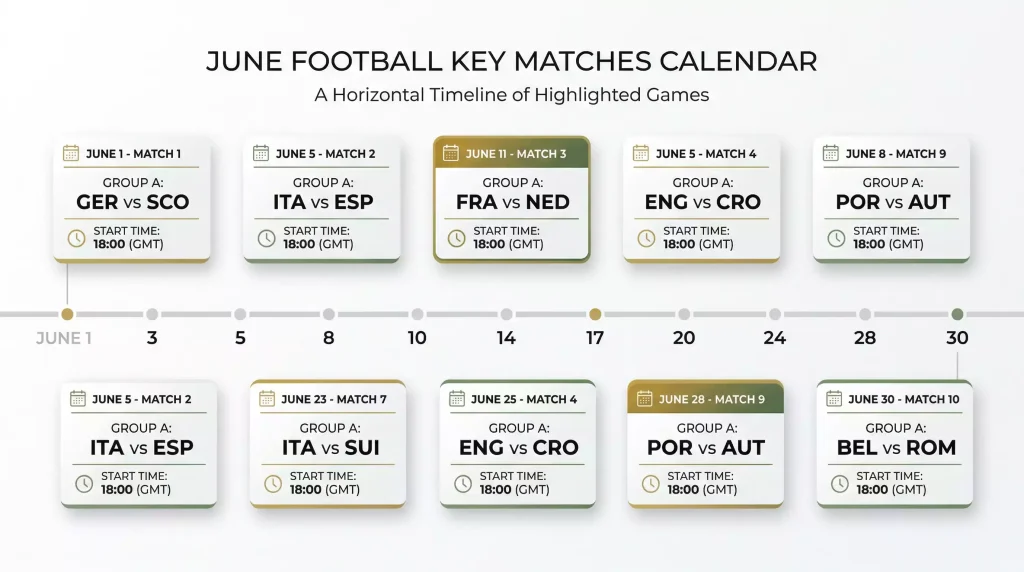
The group stage runs from 11 June to 28 June 2026. Not every match demands attention — Germany versus Curaçao will not produce drama — but several fixtures will shape the tournament narrative. I have selected ten that merit blocking out time in your calendar.
| Match | Group | Date | Kick-Off (IST) | Venue |
|---|---|---|---|---|
| Mexico vs South Africa | A | 11 June | 21:00 | Estadio Azteca, Mexico City |
| England vs Croatia | L | 15 June | 02:00 | SoFi Stadium, Los Angeles |
| Brazil vs Scotland | C | 13 June | 23:00 | MetLife Stadium, East Rutherford |
| France vs Norway | I | 14 June | 20:00 | Hard Rock Stadium, Miami |
| Spain vs Uruguay | H | 16 June | 23:00 | AT&T Stadium, Dallas |
| Netherlands vs Japan | F | 17 June | 02:00 | Lumen Field, Seattle |
| Argentina vs Algeria | J | 18 June | 20:00 | NRG Stadium, Houston |
| Portugal vs Colombia | K | 19 June | 23:00 | Mercedes-Benz Stadium, Atlanta |
| Morocco vs Scotland | C | 23 June | 20:00 | Lincoln Financial Field, Philadelphia |
| England vs Serbia | L | 25 June | 23:00 | Gillette Stadium, Boston |
The opening match — Mexico vs South Africa — sets the tournament tone. England vs Croatia repeats their 2018 semi-final in a group-stage context. France vs Norway pits Mbappé against Haaland in a clash that defines Group I. Spain vs Uruguay is a genuine six-pointer between trophy contenders. And Morocco vs Scotland is the match that determines whether Scottish dreams survive into the knockouts.
Group Stage Betting — Best Markets and Angles
The group stage offers different betting opportunities than the knockouts. Understanding which markets carry value during this phase sharpens your edge.
Group winner bets resolve within seventeen days. The prices are often short — Brazil at 2/7, Argentina at 1/4 — but combining two or three confident selections into an accumulator generates respectable returns. I target groups where the favourite is 4/9 or shorter and build trebles: England, Germany, and France to top their groups combines at approximately 2.9 decimal odds, a modest but reliable return.
Team to qualify is the smarter play in competitive groups. Scotland at 5/2 to qualify from Group C prices in the third-place pathway. Japan at 6/4 to qualify from Group F offers value given their upset pedigree. These bets carry more variance than backing favourites but offer asymmetric upside.
Over/under goals markets reflect group-stage scoring patterns. Opening matches are often cagey — teams feel each other out, fear early elimination — while final group games produce chaos as stakes clarify. I lean under in matchday one fixtures between competitive sides, and over in matchday three fixtures where at least one team needs a result. The 2022 World Cup group stage averaged 2.7 goals per game; this tournament’s expansion and mismatch potential could push that higher.
Both teams to score (BTTS) is attractive in groups with attacking sides. Group F (Netherlands, Japan, Tunisia, Sweden) should produce high-scoring affairs. Group H (Spain, Uruguay, Saudi Arabia) features teams that create chances. BTTS accumulator across three or four matches in these groups offers value at combined odds around 5/1.
In-play opportunities multiply during the group stage because of the sheer volume — four matches per day on busy schedules. A goal changes momentum; a red card reshapes odds; an injury to a key player mid-match creates value on the affected side. I allocate 20 per cent of my group-stage bankroll to in-play betting, capping stakes at one unit per wager to manage variance.
FAQ
The group stage sets the tone for everything that follows. The twelve pools offer distinct narratives — from Brazil’s expected dominance in Group C to the competitive chaos of Group F, from Argentina’s coronation march in Group J to the England-Croatia rematch in Group L. The full fixture schedule in Irish Standard Time maps every match to your local evening or late-night viewing. Study the groups, identify your angles, and stake with discipline. Sixty-four matches across eighteen days offer more opportunities than any previous World Cup — use them wisely.
