
Group J — Argentina, Algeria, Austria & Jordan
 Available in US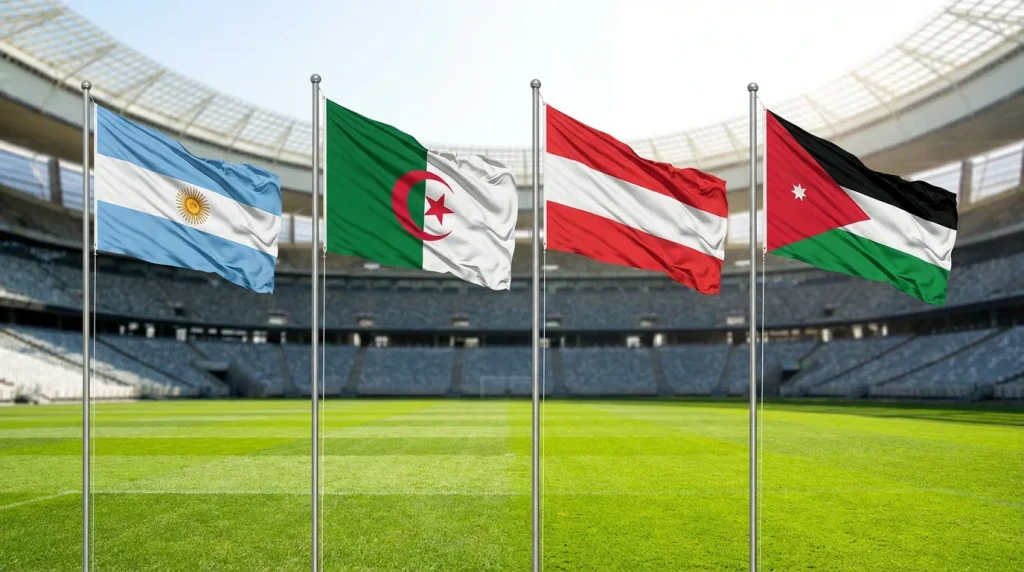
Table of Contents
Does Lionel Messi play at the 2026 World Cup? This question matters more for Group J analysis than any tactical consideration or form assessment. Messi will be 38 years old when the tournament begins, his Inter Miami career winding toward conclusion, his international retirement an ever-present possibility. If he plays, Argentina remain favourites to retain the trophy they won through his 2022 brilliance. If he does not, we are analysing a fundamentally different team — still excellent, but lacking the transcendent quality that elevated them above France in that extraordinary final. Group J context depends entirely upon this unresolved question.
Argentina — Can Champions Repeat?
Winning the 2022 World Cup should have ended the conversation about Messi’s place in football history. Instead, it merely shifted debate toward whether Argentina can win consecutive tournaments — a feat achieved only by Italy (1934-38) and Brazil (1958-62). The circumstances favour skepticism: Messi’s age, the World Cup’s expanded format creating additional knockout matches, and the simple reality that repeating championship quality requires sustained excellence that even great teams rarely maintain. Yet dismissing Argentina would be foolish given their talent depth and tournament experience.
Lionel Scaloni’s management has provided stability that previous Argentine coaches could not achieve. His tactical flexibility allows Argentina to dominate possession against weaker opponents or defend counter-attacking systems against stronger ones. The supporting cast around Messi — Enzo Fernández, Julián Álvarez, Alexis Mac Allister — would constitute World Cup contenders for most nations. Argentina’s quality ceiling approaches any team in the tournament, their floor remains consistently high, and their championship mentality derives from actually having won championships.
Group J should present minimal challenges for Argentine ambitions. Algeria, Austria, and Jordan each possess significant limitations that Argentine quality should exploit comfortably across three fixtures. Nine points and group victory represent reasonable expectations — anything less would suggest concerning decline that knockout opponents might exploit. The group stage exists for Argentina to reaffirm championship credentials before meaningful knockout tests arrive.
Argentina to win Group J at odds around 1/5 (1.20 decimal) offers no betting value despite near-certainty. More interesting angles include Argentina team totals over 2.5 goals against Jordan at approximately 1/2 (1.50 decimal), or Argentina to win all three group matches at around 4/6 (1.67 decimal). Individual match markets provide better value than outright positions for heavily favoured defending champions. For tournament believers, Argentina outright winner around 9/2 (5.50 decimal) represents reasonable odds for championship repetition.
Algeria — African Ambitions
Algerian football peaked at the 2019 Africa Cup of Nations, a continental triumph that announced their quality to audiences who had ignored North African football development. Riyad Mahrez’s creative excellence combined with defensive organisation that frustrated more talented opponents. That success raised expectations for the 2022 World Cup — expectations brutally deflated when Algeria failed to qualify, their playoff defeat to Cameroon extending an absence that began after 2014. Qualification for 2026 represents recovery, but whether championship-level quality returned remains uncertain.
The current Algerian squad has experienced generational transition since their 2019 peak. Mahrez remains but approaches career conclusion, his peak seasons at Manchester City now behind him. Younger players have emerged without yet proving capable of carrying national team expectations that Mahrez’s generation established. Algeria function best when collective organisation compensates for individual limitations — pressing with intensity, defending with discipline, and striking efficiently when opponents create openings through impatience.
Group J positions Algeria against daunting opposition. Argentina’s defending champions quality should prove overwhelming regardless of Algerian effort. Austria represent competitive European opposition with similar tactical approaches. Jordan offer winnable opponents where Algerian superiority should prove decisive. The realistic pathway involves defeating Jordan, competing against Austria, and limiting damage against Argentina — a combination that might produce third-place points sufficient for expanded knockout qualification.
Algeria to qualify from Group J at odds around 4/1 (5.00 decimal) represents speculative value for those believing North African grit can overcome European organisation. More realistic angles include Algeria to beat Jordan at around 4/5 (1.80 decimal), a fixture where their quality advantage should prove decisive. Algeria versus Austria draw at approximately 11/4 (3.75 decimal) reflects both teams’ tendency toward tactical discipline in significant matches. I view Algeria as potential third-place qualifiers rather than automatic knockout participants.
Austria — Central European Consistency
Austrian football has achieved remarkable consistency without ever producing breakthrough tournament results. They qualify for major competitions regularly — Euro 2016, Euro 2020, Euro 2024, World Cup 2026 — but knockout round progression has eluded them at each opportunity. The pattern suggests a quality ceiling that tournament pressure reveals: capable enough to navigate qualification, insufficient against elite opposition when circumstances demand excellence rather than competence. Whether this generation can break that pattern remains Group J’s secondary narrative.
Ralf Rangnick’s appointment brought tactical identity that Austrian football previously lacked. His pressing systems have transformed Austria from reactive competitors into proactive opponents who impose their style regardless of opposition quality. David Alaba’s injury history creates uncertainty at the back, but the emergence of younger defensive options suggests adaptation capacity. Austrian football depth derives from Bundesliga pathways — their players develop in Germany’s competitive environment before returning internationally matured.
Group J requires Austria to defeat Algeria and Jordan while accepting Argentine superiority. This pathway to second place appears achievable given their quality levels relative to African and Asian opponents. The Argentina fixture becomes damage limitation — avoiding heavy defeat while conserving energy and avoiding suspensions for subsequent matches. Austrian discipline serves this approach well, their tactical awareness creating circumstances where professional execution should produce required results.
Austria to qualify from Group J at odds around 6/5 (2.20 decimal) offers reasonable value given their pathway to second place. Victories against Algeria and Jordan combined with competitive loss to Argentina produces the six points typically required for advancement. Austria to finish exactly second at approximately 5/4 (2.25 decimal) provides even more specific value for those confident in their consistency. I view Austria as probable qualifiers unless Algeria exceed expectations.
Jordan — West Asian Pioneers
Jordan’s World Cup qualification represents one of the 2026 tournament’s most inspiring storylines. A nation with limited football infrastructure, competing against Asian powers with significantly greater resources, navigated qualification pathways that favoured established competitors. Their 2023 Asian Cup final appearance — losing narrowly to Qatar — demonstrated improvement that qualification confirmed. Jordan arrive at the World Cup as pioneers, their presence potentially inspiring football development across a region where the sport competes with other priorities.
The Jordanian squad relies on organisation and effort rather than individual quality that approaches international class. No players compete at European football’s top levels, creating collective limitations that tactical discipline cannot fully overcome. Jordan’s approach emphasises defensive structure and set-piece opportunities — making themselves difficult to break down while hoping opponents’ impatience creates counter-attacking chances. Against World Cup-level opposition, this approach produces respectability rather than results.
Group J presents Jordan with opponents whose quality should prove overwhelming. Argentina’s defending champions, Algeria’s African pedigree, and Austria’s European organisation each possess advantages that Jordanian resources cannot match. The realistic goal involves representing West Asian football honourably, demonstrating improvement that justifies their qualification pathway without expecting points that opposition quality makes improbable. Competitive scorelines constitute success; points would be remarkable.
Jordan betting markets offer extremely limited appeal given their quality ceiling. The most interesting angle might be Jordan to score in any match at odds around 4/6 (1.67 decimal), reflecting their capability to trouble opponents in isolated set-piece situations. Jordan +2.5 Asian handicap against Argentina at approximately 10/11 (1.91 decimal) provides insurance against comprehensive defeat. I would generally avoid Jordanian markets unless seeking long-shot novelty rather than value identification.
The Messi Factor
No individual player influences World Cup analysis more than Lionel Messi’s participation status affects Argentina’s 2026 prospects. His decision to play or retire will ripple through betting markets, tactical assessments, and tournament predictions. Understanding both scenarios matters for anyone analysing Group J with genuine betting intent. The uncertainty itself creates opportunity for those willing to commit before clarity emerges.
If Messi plays, Argentina remain among three or four genuine championship favourites. His presence elevates teammates through both tactical influence and psychological inspiration. Argentine players perform differently knowing Messi watches, knowing their contributions support his legacy pursuit. This intangible effect compounds his still-elite technical contributions — the passing, the dribbling, the vision that creates opportunities from nothing. Argentina with Messi are World Cup contenders; market prices reflect this reality.
If Messi retires before the tournament, Argentina become excellent but not transcendent. Enzo Fernández, Julián Álvarez, and Alexis Mac Allister provide quality that justifies knockout expectations without championship probability. The team would transition from Messi-centric to collectively balanced, their style shifting toward the modern intensity that Scaloni’s tactics already emphasise. Betting markets would adjust significantly — Argentina outright would drift from 9/2 toward 8/1 or longer, creating opportunity for those who anticipated the retirement before public announcement.
For Group J specifically, Messi’s participation matters less than tournament implications suggest. Argentina should win the group regardless, their squad depth ensuring dominance even without their greatest player. The betting value lies in tournament outright markets rather than group positions — prices will fluctuate dramatically once Messi’s decision becomes public knowledge. Those who commit before announcement, correctly predicting his choice, gain significant edge.
Fixtures & Kick-Off Times (IST)
Group J scheduling provides accessible viewing windows for Irish audiences following Argentina’s title defence. Most fixtures fall during evening hours that permit comfortable viewing without overnight commitment. The Argentina matches receive prime positioning that acknowledges their audience appeal, with neutral fixtures distributed across time slots that maintain group coverage continuity.
| Date | Match | Kick-Off (IST) | Venue |
|---|---|---|---|
| 17 June 2026 | Argentina vs Jordan | 23:00 | TBC |
| 18 June 2026 | Algeria vs Austria | 17:00 | TBC |
| 22 June 2026 | Argentina vs Algeria | 23:00 | TBC |
| 23 June 2026 | Austria vs Jordan | 17:00 | TBC |
| 27 June 2026 | Argentina vs Austria | 20:00 | TBC |
| 27 June 2026 | Algeria vs Jordan | 20:00 | TBC |
Opening fixtures establish immediate group context. Argentina versus Jordan at 23:00 IST requires late viewing but should confirm defending champions’ quality through comfortable victory. Algeria versus Austria the following afternoon at 17:00 IST represents the group’s most significant non-Argentine fixture — the winner gains decisive advantage in the competition for second place. These opening results will likely determine qualification outcomes before final matchday arrives.
Matchday two brings Argentina versus Algeria at 23:00 IST — the fixture where African hopes face South American reality. Argentine quality should prove overwhelming regardless of Algerian effort, though competitive scoreline seems probable given Algerian defensive organisation. Austria versus Jordan at 17:00 IST offers Austrian opportunity for comfortable victory that confirms second-place probability. Both fixtures should advance group narratives toward predictable conclusions.
Final matchday fixtures at 20:00 IST provide accessible evening viewing for Irish audiences. Argentina versus Austria tests Austrian defensive organisation against championship-calibre attacking quality. Algeria versus Jordan becomes decisive for third place — the winner likely claims the position with best chance of qualifying among third-placed teams. By this stage, Argentine group victory should be secure, with remaining drama involving subordinate positions.
Predictions & Odds
Group J hierarchy appears straightforward despite competitive elements in non-Argentine fixtures. Argentina possess quality that should overwhelm all three opponents across nine-point campaigns. Austria’s European consistency should secure second place ahead of Algerian and Jordanian challenges. The only genuine uncertainty involves Algeria versus Austria — a fixture that likely determines who accompanies Argentina into knockout rounds.
My predicted final standings: Argentina first with nine points from three comfortable victories. Austria second with six points, defeating Algeria and Jordan while losing competitively to Argentina. Algeria third with three points, their victory over Jordan insufficient when combined with defeats to Argentina and Austria. Jordan fourth with zero points, outclassed throughout but representing West Asian football with dignity.
| Team | To Win Group | To Qualify (Top 2) | To Finish 3rd |
|---|---|---|---|
| Argentina | 1/5 (1.20) | 1/25 (1.04) | 40/1 (41.00) |
| Austria | 5/1 (6.00) | 6/5 (2.20) | 3/1 (4.00) |
| Algeria | 9/1 (10.00) | 4/1 (5.00) | 11/10 (2.10) |
| Jordan | 150/1 (151.00) | 66/1 (67.00) | 7/2 (4.50) |
Austria to qualify from Group J at 6/5 (2.20 decimal) represents my strongest conviction in this group. Their European consistency, tactical organisation under Rangnick, and favourable fixtures against Algeria and Jordan create achievable pathway to second place. I view Austria as probable qualifiers unless Algerian ambition significantly exceeds recent performances.
Argentina match markets offer better value than group positions. Argentina over 2.5 goals against Jordan at approximately 1/2 (1.50 decimal) should land comfortably. Argentina to win all three group matches at around 4/6 (1.67 decimal) provides reasonable odds for championship-calibre dominance. For tournament believers, monitoring Messi participation news creates arbitrage opportunities that shrewd bettors can exploit.
For detailed analysis across the full tournament draw, the World Cup 2026 groups hub provides comprehensive context that informs strategic betting decisions.
