
Estadio Azteca — World Cup 2026 Opening Venue
 Available in US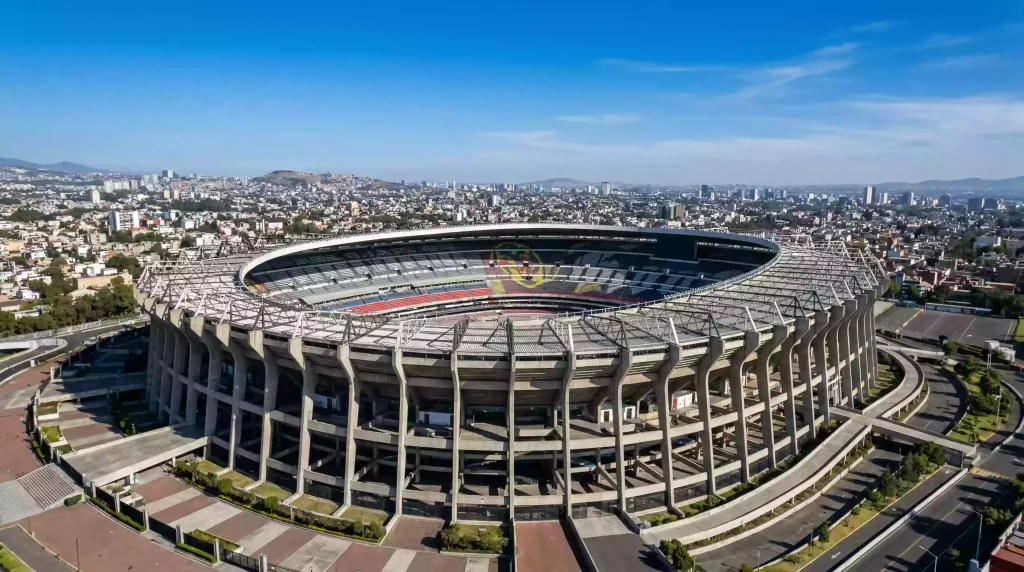
Table of Contents
No stadium on Earth carries football history quite like Estadio Azteca. Within these concrete walls, Diego Maradona scored both the Hand of God and the Goal of the Century on the same June afternoon in 1986. Pelé lifted the Jules Rimet Trophy in 1970 after Brazil’s demolition of Italy. When the World Cup 2026 opening ceremony unfolds on 11 June, Estadio Azteca will become the first venue in history to host matches across three different World Cups — a distinction that may never be equalled as tournaments rotate to new territories and pristine purpose-built facilities. The cathedral of Mexican football will reverberate once more with 87,000 voices, thin mountain air carrying their songs across the capital city below. For Irish viewers tuning in at 01:00 IST, this is where five weeks of obsessive football consumption officially begins.
About Estadio Azteca
The first time I stepped inside Estadio Azteca, my breath caught — though that might have been the altitude as much as the architecture. The stadium sits 2,240 metres above sea level in Mexico City’s southern reaches, a physiological reality that has influenced countless matches and will shape World Cup 2026 outcomes in ways bookmakers struggle to quantify. Built between 1962 and 1966 at a cost of approximately $20 million, the Azteca was designed by Mexican architects Pedro Ramírez Vázquez and Rafael Mijares Alcérreca specifically for the 1968 Olympics and 1970 World Cup. Unlike modern stadiums where commercial considerations dominate, this venue was conceived as a monument to sport itself.
The stadium’s original design seated 107,494 spectators, making it among the largest football venues ever constructed. Capacity has since been reduced to approximately 87,500 for safety compliance and improved sightlines, though this remains enormous by contemporary standards. The distinctive bowl shape creates an amphitheatre effect, with steep stands pressing toward the pitch from all angles. When filled for major fixtures, the atmosphere inside Estadio Azteca becomes genuinely overwhelming — noise echoes and amplifies in ways that modern enclosed stadiums cannot replicate.
Club América have called Estadio Azteca home since its opening, sharing the venue with the Mexican national team for international fixtures. Cruz Azul also played here for decades before relocating, and the stadium has hosted NFL matches, concerts, and religious services drawing hundreds of thousands. This versatility reflects the venue’s position as Mexico’s premier gathering place, a cultural landmark transcending mere sporting function.
Renovations ahead of World Cup 2026 have addressed infrastructure concerns while preserving the stadium’s essential character. New seating, improved accessibility, upgraded media facilities, and enhanced hospitality areas bring the Azteca closer to modern expectations without destroying what makes it unique. FIFA’s natural grass mandate requires careful pitch management given Mexico City’s climate and altitude — groundskeepers face challenges unlike any other tournament venue.
World Cup 2026 Matches at the Azteca
Opening night belongs to Estadio Azteca. On 11 June 2026, Mexico face South Africa in the tournament’s curtain-raiser, a fixture carrying symbolic weight beyond its sporting significance. This match officially launches the expanded 48-team format, the tri-nation hosting arrangement, and football’s return to North America for the first time since 1994. The opening ceremony preceding kickoff will showcase Mexican culture to global audiences, establishing the tournament’s identity before a ball is kicked.
Mexico’s group stage schedule concentrates heavily at Estadio Azteca, maximising home advantage for the co-hosts. Following the South Africa opener, Mexico face South Korea here on 16 June before concluding their Group A campaign against Czechia on 20 June. This scheduling represents FIFA’s acknowledgment of home advantage’s commercial and sporting importance — Mexican supporters will create atmospheres that visiting teams find intimidating, while television audiences benefit from the Azteca’s visual distinctiveness.
Beyond Mexican fixtures, Estadio Azteca hosts additional group stage matches featuring other nations. The full schedule places multiple high-profile fixtures at this venue, capitalising on the stadium’s capacity and Mexico City’s infrastructure. For Irish audiences, the kickoff times prove challenging — most matches occur between 01:00 and 02:00 IST, requiring late nights or early mornings for live viewing. The opening match at 01:00 IST on 12 June (technically early morning Irish time on that date) sets the pattern.
Knockout round fixtures at Estadio Azteca include at least one Round of 32 match and potentially later rounds depending on bracket progressions. The venue’s atmosphere makes it ideal for winner-takes-all encounters, where crowd involvement can genuinely influence outcomes. Mexico reaching knockout rounds at their home venue would create extraordinary scenes — the pressure would be immense, but so would the support.
| Round | Date | Kick-Off (IST) | Match |
|---|---|---|---|
| Opening / Group A | 11 June 2026 | 01:00 | Mexico vs South Africa |
| Group A | 16 June 2026 | 01:00 | Mexico vs South Korea |
| Group A | 20 June 2026 | 01:00 | Mexico vs Czechia |
| Round of 32 | 3 July 2026 | 01:00 | TBC |
The Only Stadium to Host Three World Cups
Estadio Azteca’s 2026 fixtures will cement a record unlikely to be challenged. No other venue has hosted matches across three separate World Cup tournaments — and given FIFA’s rotation policies, the competitive bidding process, and the commercial pressures favouring new construction, this distinction may endure indefinitely. The stadium’s journey through football history began in 1970, expanded in 1986, and will conclude (at least for World Cups) in 2026.
The 1970 World Cup introduced global audiences to Estadio Azteca during football’s golden age. Pelé’s Brazil played multiple matches here, including the iconic Final against Italy that finished 4-1 and is still considered among the greatest team performances in World Cup history. That tournament established the Azteca’s reputation as a theatre worthy of football’s most important moments. The combination of altitude, passionate Mexican support, and architectural grandeur created an atmosphere that television cameras captured but could not fully convey.
Sixteen years later, the 1986 World Cup returned to Mexico after Colombia withdrew from hosting duties. Estadio Azteca delivered its most memorable fixture on 22 June 1986 — Argentina versus England in the quarter-finals. Within four second-half minutes, Diego Maradona produced both the most controversial goal in World Cup history and arguably the greatest individual effort ever witnessed. The Hand of God and the Goal of the Century remain inseparable from this stadium, eternal companions in football mythology. Argentina would defeat West Germany in the Final here a week later, with Maradona collecting the Golden Ball as tournament MVP.
The 2026 edition connects this history to football’s present and future. Players who will appear at Estadio Azteca know they are following in footsteps carved by legends. The weight of the venue’s legacy adds psychological dimensions to every fixture — some players rise to such occasions, while others shrink from the enormity. For bettors analysing matchups here, this intangible factor deserves consideration alongside more quantifiable variables.
Preserving Estadio Azteca for a third World Cup required significant advocacy and investment. Alternative Mexican venues offered newer facilities and different logistical advantages, but none could match the Azteca’s symbolic importance. FIFA’s decision to include this stadium validates the argument that football history matters, that some venues transcend mere functionality to become sacred spaces in the sport’s collective memory.
Mexico City — Tournament Hub
Mexico City sprawls across a high-altitude valley that once held an Aztec lake, its 21 million metropolitan inhabitants creating one of the world’s largest urban concentrations. The city operates as Latin America’s cultural capital, economic powerhouse, and political centre — a status that football both reflects and reinforces. When El Tri play at Estadio Azteca, the entire metropolis effectively shuts down, streets emptying as millions gather around television screens in homes, bars, and public plazas. This devotion to the national team creates atmospheres unlike any other World Cup host city.
For international visitors, Mexico City offers extraordinary depth of experience between matches. Pre-Hispanic ruins at Teotihuacán and Templo Mayor provide historical context stretching back millennia. Colonial architecture in the Centro Histórico reflects Spanish influence, while contemporary neighbourhoods like Roma, Condesa, and Coyoacán showcase Mexico’s modern creative energy. The culinary scene ranks among the world’s finest, with street food traditions coexisting alongside innovative restaurants pushing Mexican cuisine into new territories.
Accommodation options span budget hostels to luxury hotels, with the tournament creating predictable demand pressures for June and July 2026. Neighbourhoods near Estadio Azteca include Coyoacán and Tlalpan, though many visitors prefer staying in more central areas like Roma Norte or Polanco despite the longer journey to the stadium. Public transportation via the Metro system provides affordable connections throughout the city, though matchday crowds will strain capacity on lines serving the Azteca.
Safety concerns require honest acknowledgment. Mexico City’s crime rates exceed those of typical European or American cities, and visitors should exercise appropriate caution regarding valuables, late-night movement, and unfamiliar areas. That said, millions of tourists visit annually without incident, and World Cup periods typically see enhanced security measures in major venues and tourist zones. Sensible precautions allow enjoyable experiences in this extraordinary metropolis.
Altitude Factor — How 2,240m Affects the Game
Betting on football matches at Estadio Azteca without understanding altitude effects is like betting on horse racing without checking the going. At 2,240 metres above sea level, Mexico City’s thin air fundamentally alters how football is played. Oxygen availability drops approximately 20% compared to sea level, forcing cardiovascular systems to work harder for equivalent outputs. Teams unaccustomed to these conditions face genuine physiological disadvantages that statistics and form guides cannot fully capture.
The practical implications manifest throughout matches. Pressing intensity cannot be sustained — teams that attempt high-energy defensive approaches from the opening whistle often find themselves exhausted by the 60th minute. Substitution patterns favour earlier changes, particularly for midfielders doing the most running. The ball itself behaves differently, moving faster through thinner air with less resistance, potentially affecting shooting accuracy and goalkeeper reactions.
Mexican players hold inherent advantages from regular exposure to these conditions. The national team’s Azteca record reflects this edge — visiting teams consistently underperform their expected levels when playing here. For World Cup 2026, this factor advantages Mexico throughout their group stage campaign. Opponents like South Africa, South Korea, and Czechia will arrive days or weeks before their matches, attempting acclimatisation that can only partially compensate for lifelong adaptation.
Acclimatisation strategies vary in effectiveness. Arriving two to three weeks before competition allows some physiological adjustment, though full adaptation requires months of continuous exposure. Some teams will use altitude training camps in the weeks preceding their Azteca fixtures, attempting to replicate conditions before exposure to the genuine environment. These preparations help but cannot eliminate the home team’s embedded advantage.
For bettors, altitude considerations should influence several market approaches. Mexico’s matches at Estadio Azteca warrant adjustment toward home victory outcomes beyond typical home advantage models. Total goals markets might trend lower as fatigue limits attacking intensity in latter match stages. First-half goals could prove more reliable than second-half markets as visiting teams retain more energy early. These edges are subtle but real — the altitude factor represents genuine market inefficiency for those willing to incorporate it into their analysis.
For complete match scheduling across all World Cup 2026 venues with kick-off times in Irish Standard Time, the dedicated schedule page provides comprehensive tournament planning resources.
