
Group A — Mexico, South Korea, South Africa & Czechia
 Available in US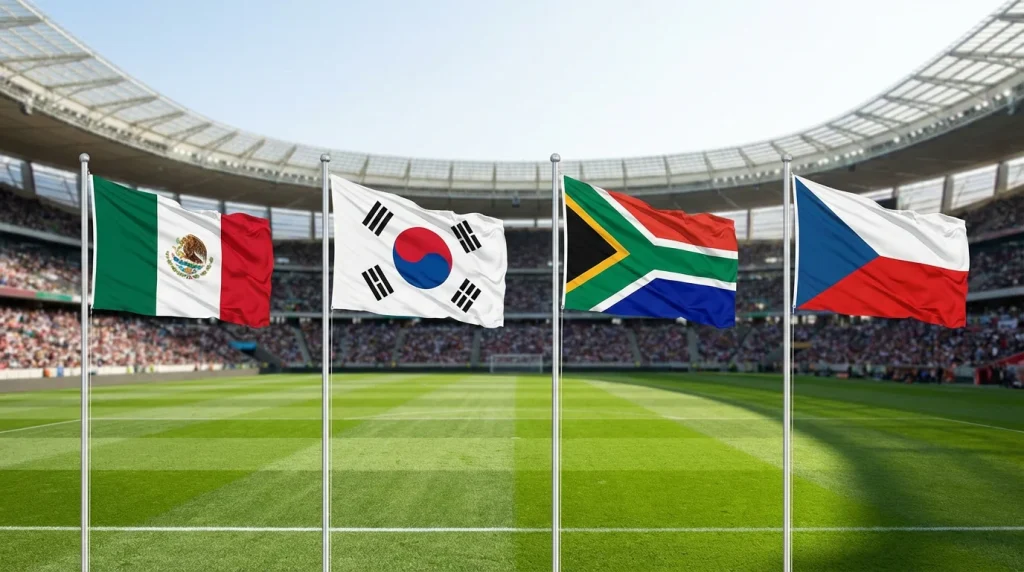
Table of Contents
Penalty kicks have a peculiar way of haunting nations. For Irish supporters, the image of Czechia celebrating at the Aviva Stadium after that March 2025 shootout remains painfully fresh — and now those same Czech players will contest Group A of the 2026 World Cup while Ireland watches from home. The group itself offers a fascinating cocktail of storylines: Mexico playing on home soil with a nation’s expectations crushing down on every pass, South Korea bringing the technical precision that has defined their recent World Cup performances, South Africa returning to football’s grandest stage after a lengthy absence, and Czechia riding the momentum of their playoff triumph. Opening night belongs to Mexico against South Africa at Estadio Azteca, the cathedral of Mexican football, where 87,000 voices will attempt to will their team through what many view as a straightforward path to the knockout rounds. But straightforward paths have a habit of developing unexpected potholes.
Group A at a Glance
I remember sitting in a Mexico City bar during the 2018 World Cup, watching grown men weep when South Korea’s late goals against Germany accidentally sent El Tri through to the last sixteen. Now these two nations share a group again, though the circumstances could not be more different. Mexico enters as co-hosts with every advantage stacked in their favour: familiar pitches, home support, and no travel fatigue between matches. South Korea arrives as Asia’s most consistent World Cup performers, having reached the knockout rounds in three of their last six tournaments. South Africa brings the weight of representing an entire continent’s hopes, while Czechia carries the quiet confidence of a team that has already proved they can perform under pressure.
The group dynamics create several intriguing subplots. Mexico should cruise to first place — their record at home is formidable, and the Azteca’s altitude provides a genuine physiological advantage over visiting teams. The real battle concerns second place and possibly a third-place finish strong enough to advance. Eight third-placed teams will progress to the Round of 32, which fundamentally changes how teams approach this group stage. A draw against Mexico might be celebrated rather than mourned. Goal difference could matter enormously.
Group A matches take place across Mexico City and potentially other North American venues, with scheduling designed to maximise television audiences across multiple time zones. For Irish punters watching from home, most kickoffs fall during late evening Irish Standard Time — civilised hours compared to some of the tournament’s more punishing timeslots. The opening match between Mexico and South Africa on 11 June 2026 at Estadio Azteca will set the tone not just for this group but for the entire tournament. If South Africa can survive with a point, suddenly this group becomes far more competitive than the odds suggest.
Mexico — Hosts & Favourites
There is something uniquely Mexican about the relationship between national team football and existential drama. No other country quite matches their capacity for turning routine qualification campaigns into telenovela-worthy sagas, nor their ability to underperform spectacularly despite obvious talent. Yet the home advantage changes the calculation entirely. Mexico last hosted a World Cup in 1986 — the tournament of Maradona’s Hand of God and his sublime solo goal against England — and finished as quarterfinalists. That benchmark haunts every subsequent generation.
The current squad possesses the quality to advance deep into this tournament. A blend of European-based talent and Liga MX veterans provides tactical flexibility, while the emergence of several exciting attackers has given the team a cutting edge that previous iterations lacked. What worries me is the weight of expectation. Mexican supporters do not merely hope for success; they demand it with a fervour that can suffocate players unaccustomed to such scrutiny. The opening match against South Africa will be watched by an estimated television audience of over 40 million Mexicans, and the pressure to deliver an emphatic victory will be immense.
Tactically, Mexico favours a possession-based approach that suits the technical abilities of their midfield. Playing at altitude — Mexico City sits at 2,240 metres above sea level — provides a physiological advantage that visiting teams struggle to overcome. Oxygen debt accumulates faster, pressing becomes more exhausting, and the ball moves differently through thinner air. South Africa discovered this during pre-tournament friendlies, where the adjustment period proved difficult. Mexico’s coaching staff understands precisely how to exploit these conditions.
From a betting perspective, Mexico to win Group A represents poor value despite being the most likely outcome. Odds around 1/3 (1.33 decimal) simply do not justify the stake when considering the margins for error are slim. I prefer looking at Mexico-specific player markets, where the odds better reflect genuine uncertainty. Total team goals across the group stage offers an interesting angle — three matches on home soil against beatable opposition should produce plenty of scoring opportunities.
South Korea — Asian Contenders
Son Heung-min’s Champions League final goal for Tottenham back in 2019 remains one of my clearest football memories from that era. The pure technique, the composure, the understanding of exactly where the goalkeeper would move. That same player now leads South Korea into what might be his final World Cup, carrying expectations that rival any European superstar. Korean football culture demands excellence from its leading figures, and Son has delivered consistently at club level. The question is whether this Korea team possesses the supporting cast to make his World Cup a successful one.
The Korean squad has evolved significantly since their 2022 World Cup campaign, where they reached the Round of 16 before falling to Brazil. A new generation of European-based players has emerged, supplementing Son with midfielders capable of controlling possession and defenders comfortable in high-pressing systems. The Korean domestic league continues developing talent, though the gap between K-League quality and Europe’s top divisions remains substantial. What Korea brings is organisational excellence — their defensive shape under pressure ranks among the best in Asian football, and they rarely concede soft goals.
The draw has been kind to South Korea in some respects. They avoid the tournament favourites entirely during the group stage, and both Mexico and Czechia represent beatable opposition on neutral ground. South Africa presents the clearest opportunity for three points, though underestimating African opponents has burned many teams throughout World Cup history. Korea’s path to qualification likely requires maximum points from that South Africa fixture, a draw against either Mexico or Czechia, and sufficient goal difference to finish second or claim one of the best third-place positions.
I rate Korea as genuine contenders for second place in Group A, and the odds available — typically around 5/2 (3.50 decimal) for top-two finish — represent fair value. The team has World Cup pedigree, a genuine superstar, and the tactical discipline to frustrate higher-ranked opponents. Their group stage record across recent tournaments shows consistency: this is not a team prone to inexplicable collapses against inferior opposition.
South Africa — African Representatives
Hosting the 2010 World Cup gave South Africa their moment under the global spotlight, but the football itself disappointed. The Bafana Bafana became the first host nation eliminated in the group stage, a humiliation that still stings. Returning to the World Cup after an extended absence carries enormous significance — not just for South African football but for a nation still grappling with complex social challenges. Sport provides escapism and unity in ways that few other activities can match.
The current South African squad emerged through a competitive African qualification process that demonstrated both their quality and their limitations. They possess pace in wide areas, physical presence through the middle, and several technically gifted individuals. What they lack is the experience of competing regularly against Europe and South America’s elite. The Premier Soccer League provides a decent standard of football, but the intensity differential between domestic competition and World Cup knockout football is substantial.
South Africa’s tournament strategy will likely prioritise defensive solidity over expansive attacking football. Against Mexico in the opening match, survival represents success — a goalless draw at the Azteca would be celebrated across the country, regardless of how aesthetically unpleasing the performance might appear. The subsequent matches against South Korea and Czechia offer genuine opportunities for points, particularly if those opponents are already thinking about knockout round preparations.
The betting markets undervalue South Africa’s chances of progressing as one of the best third-placed teams. Eight teams from that position advance, meaning four points from three matches might be sufficient. A win against Czechia combined with competitive defeats to Mexico and South Korea could see South Africa through. Odds around 11/4 (3.75 decimal) for third place in the group offer a value proposition that casual bettors often overlook.
Czechia — Ireland’s Play-Off Nemesis
I will confess to finding objectivity difficult when discussing Czech football. That penalty shootout in Dublin, the agonising misses, the Czech celebrations — the memories remain too raw for clinical analysis. Yet professional obligation demands acknowledgment of their qualities. Czechia reached this World Cup because they performed under pressure when it mattered most, and that psychological resilience will serve them well in Group A.
The Czech squad blends experienced internationals with emerging talent from their domestic league and various European clubs. Their tactical approach leans towards pragmatism over aesthetics — they will not thrill neutrals with flowing football, but they are exceptionally difficult to break down. Compact defensive shapes, disciplined positioning, and an ability to absorb pressure characterise their play. When opportunities arise on the counter-attack, they possess the quality to finish.
Group A presents Czechia with a realistic path to the knockout rounds. They should fear Mexico’s home advantage but not their quality; the gap between teams is far narrower than oddsmakers suggest. South Korea represents a stylistic challenge — Korea’s pressing intensity will test Czech composure — while South Africa offers the best opportunity for three points. The sequence of fixtures matters enormously. If Czechia can take four points from their first two matches, the final game against Mexico becomes either dead rubber or opportunity.
Czech qualification odds around 2/1 (3.00 decimal) reflect their status as genuine contenders rather than mere participants. This is a team with World Cup experience, European pedigree, and the proven ability to handle tournament pressure. Irish bettors nursing playoff wounds might find backing Czechia difficult emotionally, but the head must rule the heart when money is involved. They represent solid value for a top-two finish.
Group A Fixtures & Kick-Off Times (IST)
The scheduling gods have been relatively kind to European viewers following Group A. Most matches fall during evening hours Irish time, avoiding the nocturnal viewing that plagued the 2002 Japan/Korea tournament. Opening night brings Mexico versus South Africa on 11 June 2026, with kickoff at 01:00 IST — technically the following morning, but early enough that dedicated fans can watch without destroying their entire sleep schedule. The atmosphere at Estadio Azteca will be extraordinary, with 87,000 supporters creating the kind of wall of sound that visiting players rarely experience.
The full Group A fixture schedule runs as follows, with all times converted to Irish Standard Time:
| Date | Match | Kick-Off (IST) | Venue |
|---|---|---|---|
| 11 June 2026 | Mexico vs South Africa | 01:00 | Estadio Azteca, Mexico City |
| 12 June 2026 | South Korea vs Czechia | 23:00 | TBC |
| 16 June 2026 | Mexico vs South Korea | 01:00 | Estadio Azteca, Mexico City |
| 16 June 2026 | South Africa vs Czechia | 20:00 | TBC |
| 20 June 2026 | Mexico vs Czechia | 01:00 | TBC |
| 20 June 2026 | South Korea vs South Africa | 01:00 | TBC |
The simultaneous kickoffs on matchday three reflect FIFA’s standard practice of preventing tactical manipulation. When teams know exactly what result they need, the temptation to engineer mutually beneficial outcomes becomes significant. Simultaneous matches eliminate this possibility, ensuring competitive integrity through to the final whistle.
For Irish viewers planning their schedules, the South Africa versus Czechia fixture on 16 June at 20:00 IST offers the most comfortable viewing time. This match could prove pivotal for third-place calculations, making it essential viewing for anyone following Group A closely. The late-night/early-morning slots for Mexico matches require commitment, but the atmosphere and quality should reward those who stay awake.
Qualification Predictions & Odds
Nine consecutive World Cup tournaments have taught me to approach predictions with humility. The beautiful game delights in humiliating confident forecasters. Yet patterns emerge over time, and Group A follows recognisable templates from previous competitions. A dominant host nation against three teams separated by margins thin enough that individual matches determine everything.
Mexico will win Group A. This prediction requires no analytical sophistication — home advantage at this level is worth at least a goal per game, and Mexico possesses sufficient quality to beat every opponent regardless of venue. Their only real danger is complacency, the assumption that qualification is guaranteed regardless of effort. Given the national obsession with World Cup success, complacency seems unlikely.
Second place represents the genuine uncertainty. I give South Korea a slight edge over Czechia based on attacking quality and World Cup experience, but the margin between them is negligible. South Africa could upset either team on a given day, though sustaining that level across three matches seems beyond them. My predicted final standings: Mexico (9 points), South Korea (4 points), Czechia (3 points), South Africa (1 point).
| Team | To Win Group | To Qualify (Top 2) | To Finish 3rd |
|---|---|---|---|
| Mexico | 1/3 (1.33) | 1/10 (1.10) | 12/1 (13.00) |
| South Korea | 5/1 (6.00) | 4/6 (1.67) | 7/4 (2.75) |
| Czechia | 6/1 (7.00) | 4/5 (1.80) | 6/4 (2.50) |
| South Africa | 16/1 (17.00) | 7/2 (4.50) | 11/8 (2.38) |
Value betting opportunities exist at the margins. South Korea to qualify at 4/6 represents fair odds for what I consider a likely outcome. Czechia finishing third offers decent value given the eight-team advancement from that position. I would avoid South Africa for outright qualification but consider them for double chance markets in individual matches — particularly against Czechia, where their physical approach could cause problems.
The most interesting betting angle concerns Mexico’s margin of group victory. Winning all three matches by two goals or more pays handsomely, and home advantage combined with altitude should produce comfortable victories. If you believe Mexico will dominate as expected, the Asian handicap markets offer better returns than simple match result betting.
For a complete overview of all twelve World Cup 2026 groups and qualification pathways, the dedicated hub provides comprehensive analysis of every team’s prospects.
