
The Complete World Cup 2026 Betting Guide
 Available in US
Table of Contents
Three host nations. Forty-eight teams. One hundred and four matches spread across thirty-nine days. The 2026 FIFA World Cup is the first tournament to feature the expanded format, and every additional game represents a fresh opportunity for bettors who know where to look. I have covered three World Cup cycles as a betting analyst, and I can tell you that the sheer volume of action this summer will dwarf anything we have seen before.
This World Cup 2026 betting guide is designed for punters based in Ireland who want a structured approach to the tournament. Whether you have been placing accumulators on the Premier League for years or you are opening your first betting account in time for the opening whistle at Estadio Azteca, the principles here will help you navigate markets, manage your bankroll, and identify value from group stage to final. I will walk through the tournament format, break down every major market type, explain how to read fractional and decimal odds, and address the specific considerations that apply when betting from Ireland under the new GRAI regulatory framework.
The tournament kicks off in Mexico City on 11 June 2026 and concludes with the final at MetLife Stadium in New Jersey on 19 July 2026. Irish Standard Time puts those late-night Eastern Time kick-offs into sociable evening viewing, and the group stage schedule delivers multiple matches per day for the first two weeks. That density of fixtures is what makes a World Cup so appealing for betting — and so dangerous if you wade in without a plan. Let me give you that plan.
Tournament Format — 48 Teams, 104 Matches
When FIFA confirmed the expansion from thirty-two to forty-eight teams, I remember the scepticism in betting circles. More minnows, people said. More dead rubbers. But the reality is different. The new format creates more competitive uncertainty in group stages, more pathways through the knockout rounds, and more price inefficiencies for sharp bettors to exploit.
The forty-eight participating nations are divided into twelve groups of four. Each team plays three group matches, just as in previous World Cups, so the fundamental rhythm remains intact. What changes is the knockout bracket. Instead of sixteen teams advancing to a round of sixteen, we now have thirty-two teams progressing to a round of thirty-two. The top two finishers in each group qualify automatically, accounting for twenty-four berths. The remaining eight spots go to the best third-placed teams, ranked by points, goal difference, and goals scored.
This third-place pathway is significant for betting. In a thirty-two-team format, a side that finished third was going home. Now, a team sitting on three or four points after three matches might still have a genuine chance of progression. That changes the incentive structures in final group games. A team that has lost its opening fixture but beaten a weaker opponent in match two is not mathematically eliminated; it has reason to push for a result in match three. From a punting perspective, that creates value in match betting, over/under goals, and in-play markets where the stakes remain meaningful.
Group Stage Structure
The twelve groups run from A through L. Each group contains one top-seeded team — generally the highest-ranked side from the draw pots — plus one from each lower pot. The top seeds for 2026 include Brazil, Argentina, England, France, Germany, Spain, the Netherlands, Belgium, Portugal, Mexico, USA, and Canada, with host nations receiving automatic seeding protection. Group fixtures are scheduled so that no team plays on consecutive days, and the final two matches in each group take place simultaneously to prevent collusion scenarios.
For Irish bettors, Group C and Group L deserve particular attention. Scotland return to the World Cup for the first time since 1998, facing Brazil, Morocco, and Haiti. England headline Group L alongside Croatia, Ghana, and Serbia. Whether you are backing the Scots through Celtic solidarity or following the Three Lions due to your Premier League allegiances, these groups offer natural focal points for research and wagering.
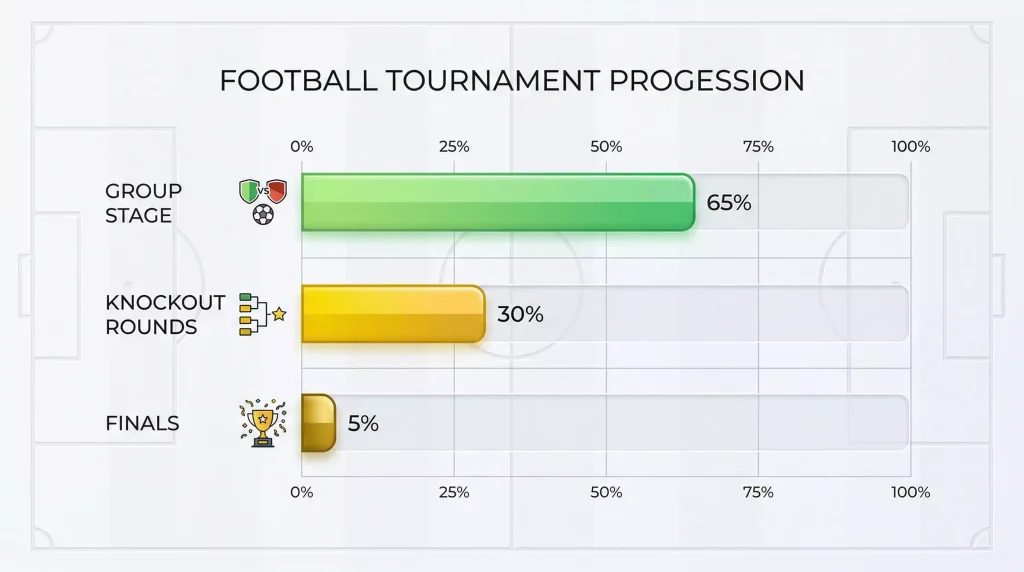
The group stage runs from 11 June to 28 June 2026. With four matches per group — each team playing three, with one rest day per round — the daily fixture density peaks at six matches on certain days during the opening fortnight. That volume means bookmakers are pricing dozens of markets simultaneously, and minor edges compound across a large number of selections.
Knockout Rounds and the Third-Place Pathway
Once the group stage concludes, the round of thirty-two begins on 29 June 2026. The bracket is fixed: Group A winner faces Group B third-place qualifier in one half, while Group A runner-up meets Group B winner in the opposite half. This cross-pollination continues through the bracket, with similar pairings repeated for all twelve groups. The bracket converges through the round of sixteen, quarter-finals, and semi-finals, culminating in the final on 19 July.
Understanding the bracket structure matters for outright and futures bets. If you fancy a dark horse like Morocco or Japan to reach the quarter-finals, you need to trace their likely knockout path. A favourable draw — avoiding Brazil or Argentina until the last eight — materially increases the probability of a deep run. Conversely, backing a strong side that lands in the more congested half of the bracket requires pricing in tougher opposition earlier.
The third-place qualification system adds a layer of unpredictability. The eight best third-placed teams are slotted into predetermined bracket positions once all groups finish. That means you cannot know, before the group stage ends, exactly who a group winner will face in the round of thirty-two. Bookmakers account for this uncertainty by widening spreads on pre-tournament futures, but as the group stage progresses, those odds adjust. Timing your bets to capitalise on that adjustment is part of the skill set this guide aims to develop.
Betting Markets Available at the World Cup
A mate of mine once described World Cup betting as “Christmas every four years, except the presents keep coming for six weeks.” He was talking about market depth. At a typical Premier League match, you might find thirty or forty distinct markets. At a World Cup knockout fixture between major nations, that number can exceed two hundred. Understanding which markets suit your analysis is essential.
The markets cluster into three broad categories: outright and futures, match betting, and player specials. Each has different characteristics, different edges, and different bankroll implications. Let me unpack them in turn.
Outright and Futures
Outright markets ask who will win the tournament, who will reach the final, or who will top a specific group. These are long-term bets that tie up your stake for weeks or months, but they also offer the largest potential payouts. Brazil currently sit around 9/2 to lift the trophy, with Argentina and France close behind. A successful fifty-euro stake on Brazil returns two hundred and seventy-five euros — not a life-changing sum, but meaningful.
The appeal of outrights lies in their ability to compound small edges over time. If you believe the market underrates a contender — say, Germany post-Euro 2024 momentum, or Spain’s golden generation 2.0 — you can lock in value early. The drawback is liquidity risk: your money is committed until the tournament ends or your selection is eliminated. For a thirty-nine-day event, that is manageable. For punters with limited bankrolls, it requires discipline.
Group winner markets operate similarly but resolve faster. Backing England to win Group L at 4/9 ties up capital for only seventeen days, and the shorter timeframe reduces variance. I often use group winner bets as building blocks for accumulators, combining two or three confident selections at short prices to create a single wager with a more attractive composite return.
Match Betting and Asian Handicaps
Match betting is the bread and butter of World Cup punting. The 1X2 market — home win, draw, away win — is the default for most casual bettors, but the World Cup is played on neutral soil for most teams, so “home” and “away” designations lose meaning. Instead, Team A win, draw, Team B win structure applies. The draw is perpetually undervalued in international football, where sides play conservatively early in tournaments, and I factor that into my group stage strategy.
Asian handicaps remove the draw from the equation by applying a goal advantage or deficit. If Brazil face Haiti with a -2.5 Asian handicap, a bet on Brazil wins only if they triumph by three goals or more. If they win 2-0, the bet loses. This market suits punters who have a strong view on margin of victory and want to avoid the frustration of a selection winning but the draw settling at short odds.
Double chance markets (1X, X2, 12) collapse three outcomes into two, offering lower returns but higher strike rates. In tight group games — think Croatia versus Serbia, or Japan versus the Netherlands — double chance can be a sensible hedge. The returns are modest, but the margin for error is wider.
Player Specials and Top Scorer
The Golden Boot market asks who will finish as the tournament’s leading scorer. Historically, this award has gone to players whose teams reach at least the semi-finals, because they simply play more matches. Kylian Mbappé, Erling Haaland, and Lionel Messi feature prominently in the betting, but value often lies with forwards from dark horse nations who carry a disproportionate goal-scoring burden. Think of James Rodríguez at the 2014 World Cup, or Oleg Salenko’s five-goal haul against Cameroon in 1994.
Anytime goalscorer markets let you back a player to score in a specific match. First goalscorer markets offer higher odds but require your selection to net before anyone else. Last goalscorer is less popular but occasionally throws up value when a substitute striker enters late. These markets reward punters who track team news closely. If a starting forward is nursing a knock and might be rested, backing his replacement at longer odds makes sense.
Assists, cards, and corners fall under player props. The assist market is volatile — a deflected pass can count, or an official might credit a different touch — so I tread carefully. Cards markets correlate with referee tendencies, which are worth researching before placing wagers on yellow-happy tournaments.
Understanding Odds — Fractional, Decimal, and Implied Probability
I spent my first year as a punter confused about why odds displayed differently across bookmakers. Some showed 5/1, others 6.00. It took an embarrassing conversation with a colleague to realise they meant the same thing. If you are new to betting or simply want clarity, this section will make those numbers intuitive.
Fractional odds are the traditional format in Ireland and Britain. A price of 5/1 means you receive five units of profit for every one unit staked, plus your original stake back. A fifty-euro wager at 5/1 returns three hundred euros: two hundred and fifty in profit, plus your fifty. The numerator (5) represents potential profit; the denominator (1) represents stake. When the denominator is larger — say, 1/2 — you must stake two units to win one. Short prices like 1/5 imply heavy favouritism: stake five to win one.
Decimal odds express the total return per unit staked. A price of 6.00 means a one-euro stake returns six euros, comprising five profit plus the original stake. To convert fractional to decimal, divide the first number by the second and add one. So 5/1 becomes (5 ÷ 1) + 1 = 6.00. And 1/2 becomes (1 ÷ 2) + 1 = 1.50. Decimal formats are cleaner for accumulator calculations because you simply multiply each leg’s decimal odds to get the combined return.
Implied probability translates odds into a percentage likelihood. For decimal odds, divide one by the decimal and multiply by one hundred. At 6.00, the implied probability is (1 ÷ 6) × 100 = 16.67 per cent. For fractional odds, divide the denominator by the sum of numerator and denominator, then multiply by one hundred. At 5/1, that is 1 ÷ (5 + 1) × 100 = 16.67 per cent. These figures help you judge whether a price offers value: if your analysis gives a team a 25 per cent chance but the market implies only 17 per cent, you have found an edge.
Bookmakers build their margin into these odds. A true fifty-fifty event would price at 2.00 on each side, summing to 100 per cent. In reality, each side might price at 1.91, summing to 104.7 per cent. That 4.7 per cent is the bookmaker’s overround, ensuring they profit over time. Lower-margin books are worth seeking out for better returns.
Bankroll Management for a 39-Day Tournament
My first World Cup as a serious bettor was 2014. I blew through two-thirds of my bankroll by the quarter-finals because I had no plan beyond “back what looks good.” That lesson cost me, but it also shaped how I approach tournament betting today. The 2026 World Cup demands structure, not impulse.
Step one: set a total bankroll for the tournament that you can afford to lose entirely without financial hardship. This is your war chest. I recommend isolating this sum from your regular savings and viewing it as an entertainment expense, like a month’s worth of pub outings or a holiday budget. Once you have that figure, divide it into units. A common approach is one hundred units per bankroll, meaning a one-thousand-euro bankroll breaks into ten-euro units.
Step two: assign stake sizes based on confidence. A standard bet might be one unit. A strong conviction play might be two or three units. Never exceed five units on a single wager unless you genuinely believe the market has mispriced by an extraordinary margin — and even then, cap yourself. Overconfidence sinks more bettors than bad luck.
Step three: schedule your betting. The group stage offers sixty-four matches over eighteen days. If you bet on every match, you will exhaust attention and bankroll alike. Select your spots: perhaps ten to fifteen group stage bets, plus three or four futures positions. Reserve at least a third of your bankroll for the knockout rounds, where you will have better data on team form, injury news, and market inefficiencies.
Step four: review daily. Log each bet, the price, the stake, the outcome, and your reasoning. This record becomes a feedback loop. After the group stage, analyse which market types delivered positive returns and which bled value. Adjust your knockout stage approach accordingly. A World Cup is long enough to course-correct; do not let stubbornness turn a slow start into a wipeout.
Variance is the hidden antagonist of tournament betting. Even well-reasoned wagers lose; a side-footed clearance off the line or a dubious VAR call can flip outcomes in seconds. Accepting variance as part of the process protects your bankroll psychologically. If you lose three confident bets in a row during the opening weekend, your framework is not broken — randomness is doing what randomness does. The goal is positive expected value over the full one hundred and four matches, not perfection in any single gameweek. Sticking to your unit system during losing streaks prevents the emotional escalation that ruins so many tournament campaigns.
One more point on bankroll timing: do not deposit your entire tournament fund on day one. Split your bankroll across two or three deposits, spacing them a week apart. This creates natural checkpoints. If your first deposit depletes midway through the group stage, pause before adding more. Review your bets, identify leaks, and only proceed if you can honestly say your approach remains sound. This friction is intentional — it stops reflex deposits fuelled by frustration rather than strategy.
Accumulators, Each-Way, and Combination Bets
The accumulator — acca, in Irish parlance — is the most popular bet type during major tournaments. It combines multiple selections into a single wager, with the winnings from each leg rolling into the next. A four-fold acca on group winners at 1.50, 1.80, 2.00, and 1.40 carries a combined decimal odd of 1.50 × 1.80 × 2.00 × 1.40 = 7.56. A ten-euro stake returns just over seventy-five euros if all four legs land.
The appeal is obvious: modest stakes can produce substantial payouts. The risk is equally obvious: a single losing leg voids the entire bet. Accumulators are high-variance instruments, and bookmakers love them because the compounded margin across legs tilts odds in their favour. I use accas sparingly, limiting them to three or four legs where I have genuine conviction on each selection.
Each-way betting splits your stake between a win bet and a place bet. In outright markets, “place” typically means reaching the final or semi-finals, depending on the bookmaker’s terms. If you back Brazil each-way at 9/2 for the win with quarter odds (1/4) for the place, a fifty-euro each-way stake costs one hundred euros total: fifty on Brazil to win at 9/2 (returning two hundred and seventy-five if they lift the trophy) and fifty on Brazil to reach the final at 9/8 (returning one hundred and six twenty-five if they reach the last two but lose). Each-way bets provide a partial hedge — you lose less if your selection falls just short.
Combination bets — patents, Trixies, Yankees — build multiple accumulators from a selection of legs. A Trixie comprises three selections and four bets: three doubles and one treble. A Yankee features four selections and eleven bets: six doubles, four trebles, and one four-fold. These structures increase cost but provide returns even if one or two legs fail. They suit punters who want acca-style action without the all-or-nothing risk.
In-Play Betting at the World Cup
The group stage match is fifteen minutes old. The favourite is pressing, has hit the woodwork twice, but the scoreboard reads nil-nil. In-play odds have drifted: the favourite was 1.40 pre-match; now it is 1.65. If your pre-match analysis suggested goals were coming, that drift represents value. This is where in-play betting shines.
In-play markets adjust continuously based on match events: goals, red cards, substitutions, momentum shifts. The speed of adjustment varies by bookmaker; some suspend markets rapidly around goal-scoring chances, while others lag. Finding books that stay open longer gives you microseconds — sometimes full seconds — to react before prices move. That edge compounds over one hundred and four matches.
The most popular in-play markets are next goal scorer, correct score, and over/under goals. I focus on over/under, because xG models and shot data translate reasonably well into goal expectancy during a match. If a team is generating 0.8 expected goals after thirty minutes but the match is goalless, backing over 1.5 or over 2.5 at inflated odds makes sense. Conversely, if a team parks the bus after going ahead, under markets become attractive.
Discipline matters more in-play than pre-match. The temptation to chase losses live, to double down when your pre-match bet is losing, is acute. I set a hard rule: no in-play bet exceeds one unit, and no more than two in-play wagers per match. If I feel the urge to exceed those limits, I step away from the screen. The tournament lasts thirty-nine days; there will be another opportunity tomorrow.
Betting from Ireland — What You Need to Know
The Gambling Regulation Act 2024 transformed the Irish betting landscape. For decades, the Betting Act 1931 governed the industry, a relic of a pre-digital era. The new framework established the Gambling Regulatory Authority of Ireland, known by its Irish acronym GRAI (Údarás Rialála Cearrbhachais na hÉireann), which began accepting licence applications in February 2026. If you are placing wagers during the World Cup, you will be doing so under the watch of a regulator that did not exist eighteen months ago.
The practical implications are largely positive for consumer protection but carry some restrictions worth understanding. Broadcast advertising of gambling is prohibited between 5:30 in the morning and 9:00 in the evening, limiting the saturation of promotional messaging during peak viewing hours. VIP membership schemes and free-bet promotions face restrictions, so the “deposit one hundred get fifty free” offers that dominated the 2022 World Cup may be less prevalent or differently structured in 2026. Credit card deposits are banned outright, pushing punters toward debit cards, bank transfers, and e-wallets.
GRAI Regulation and Licensed Operators
GRAI issues three categories of licence relevant to bettors: remote betting, in-person betting, and remote betting intermediary. The remote betting licence covers online bookmakers accessible from Ireland. If an operator holds this licence, they are compliant with deposit limits, self-exclusion tools, and responsible gambling messaging requirements mandated by Irish law. Operating without a licence is a criminal offence, and GRAI maintains a public register of licensed entities.
From a punter’s perspective, sticking to licensed operators provides legal protection and recourse in disputes. Unlicensed offshore books might offer better odds or looser limits, but you surrender regulatory safeguards. Given the strength of Ireland’s licensed market — including homegrown brands with deep local knowledge — the case for unlicensed alternatives is weak.
The regulator also mandates responsible gambling features: deposit limits, loss limits, session time limits, and self-exclusion options. These tools are there to use; if you find yourself betting more than intended, activate them. A World Cup is supposed to be enjoyable, not a source of financial stress.
Tax and Withdrawal Considerations
Ireland does not tax gambling winnings for recreational bettors. Whether you scoop fifty euros on a match result or five thousand on an outright, that money is yours to keep without reporting to Revenue. Professional bettors — those whose gambling constitutes a trade — face different treatment, but the threshold for “professional” is high and typically requires systematic, business-like activity over extended periods.
Withdrawals process in euros, and most licensed operators offer multiple methods: bank transfer, debit card reversal, PayPal, Skrill, or other e-wallets. Bank transfers can take three to five business days; e-wallets are often faster. Verify your account early in the tournament — upload identification and proof of address — so that withdrawal requests do not stall during the knockout rounds when you might want quick access to funds.
Currency considerations are minimal for Irish punters. Odds are quoted in euros, deposits and withdrawals are in euros, and there is no exchange rate risk. If you bet with a UK-based operator, ensure your account is denominated in EUR to avoid conversion fees eating into returns.
FAQ
The 2026 World Cup will test your discipline as much as your knowledge. One hundred and four matches across thirty-nine days means opportunity abounds — but so does risk. If you have read this far, you have a framework: understand the expanded format and its knockout pathways; master the markets that suit your analysis; convert between odds formats and calculate implied probability; manage your bankroll with unit-based discipline; deploy accumulators and in-play bets sparingly; and operate within Ireland’s GRAI-regulated ecosystem for both protection and peace of mind.
I will be covering this tournament match by match, group by group, refining my picks as the data rolls in. The complete odds reference provides current prices across every major market. Read it, compare it to your own assessments, and trust the work. The first whistle in Mexico City is weeks away. That is enough time to sharpen your edge and build a strategy that lasts the distance.
