
Hard Rock Stadium — World Cup 2026 Venue in Miami
 Available in US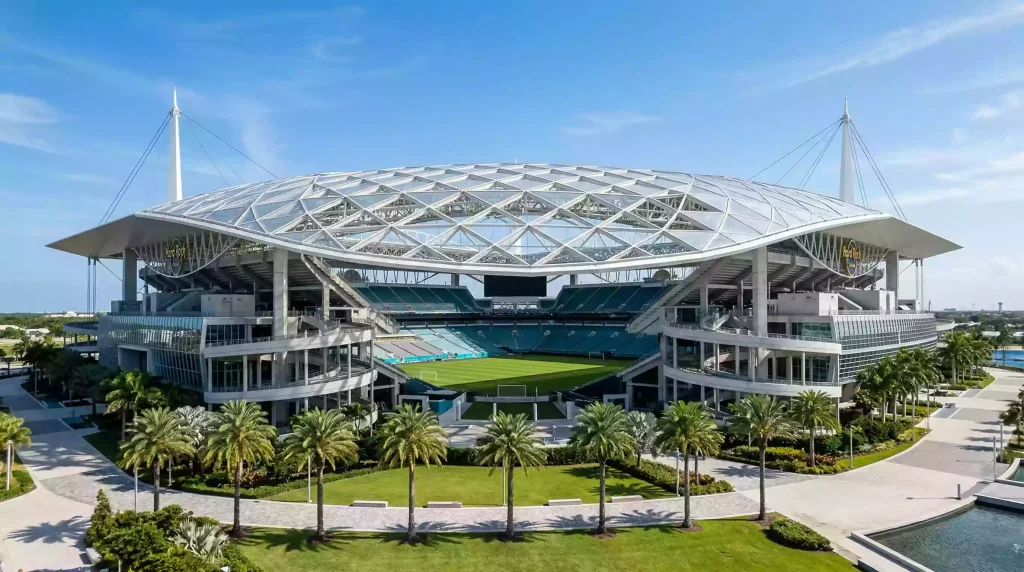
Table of Contents
South Florida heat creates its own tactical dimension. When afternoon temperatures push past 35°C and humidity saturates the air, football transforms from an athletic contest into a survival test. Hard Rock Stadium in Miami Gardens will host World Cup 2026 matches under conditions that challenge even the most conditioned athletes, with the venue’s partially open roof providing shade but little relief from the oppressive climate. For European and South American teams accustomed to temperate summers, Miami represents hostile territory of a different kind — nature rather than crowds providing the intimidation. Irish viewers tuning in from homes where 20°C constitutes a heatwave will watch players battling conditions almost unimaginable in our moderate climate.
About Hard Rock Stadium
Walking toward Hard Rock Stadium, the first thing you notice is the distinctive canopy structure that now defines its silhouette. This massive shade-providing roof was added during 2015-2016 renovations, transforming a functional NFL stadium into something approaching architectural distinction. The canopy cannot fully enclose the venue — FIFA regulations require natural grass, which needs sunlight — but it provides meaningful protection from Miami’s relentless sun. At a reconstruction cost exceeding $500 million, owner Stephen Ross created a facility capable of hosting elite global events beyond its primary NFL tenant, the Miami Dolphins.
The stadium originally opened in 1987 as Joe Robbie Stadium, named after the Dolphins’ founding owner. Subsequent naming rights deals cycled through Pro Player, Dolphin Stadium, Land Shark Stadium, and Sun Life Stadium before Hard Rock Cafe’s parent company secured the current branding in 2016. This commercial evolution mirrors American sports’ broader transformation into corporate entertainment vehicles, though the stadium itself has improved substantially with each investment phase. Current capacity for football matches approaches 65,000, placing it among the smaller World Cup venues while still delivering substantial revenue potential.
Miami’s football heritage extends beyond the Dolphins and their fluctuating NFL fortunes. The University of Miami Hurricanes have played here since 2008, bringing college football’s particular intensity to the venue. International football has featured regularly, with friendlies, Copa América fixtures, and MLS doubleheaders demonstrating local appetite for the global game. Inter Miami’s rise — accelerated by Lionel Messi’s arrival — has further embedded football into South Florida’s sporting consciousness, creating natural demand for World Cup fixtures.
The pitch installation for World Cup matches requires converting from NFL artificial turf to natural grass meeting FIFA standards. This process involves growing grass modules off-site and transporting them into the stadium, creating a playing surface that will be monitored continuously throughout the tournament. Miami’s climate presents specific challenges — heavy summer rainfall can waterlog pitches, while intense sun can stress grass beyond recovery without constant care. The groundskeeping operation represents one of the more demanding assignments across tournament venues.
World Cup 2026 Matches in Miami
Hard Rock Stadium’s match schedule spans group stage fixtures through knockout rounds, with FIFA capitalising on Miami’s international profile and substantial Latin American population. The city’s demographics favour certain matchups — Argentina, Brazil, Colombia, and Mexico fixtures here will draw enormous crowds combining local residents with visiting supporters from across the Americas. These matches create atmospheres rivalling anything produced in traditional football nations.
Group stage allocation brings several high-profile nations to Miami Gardens. The complete schedule remains subject to final FIFA confirmation, but preliminary allocations suggest multiple matches from groups containing South American and Central American teams. These fixtures benefit from natural supporter bases — Miami’s Cuban, Colombian, Venezuelan, and Argentine communities will fill stands with passionate voices regardless of official allocation processes.
Knockout round fixtures include at least one Round of 32 match, with potential for later rounds depending on bracket progressions. Miami’s position as a major American city ensures FIFA prioritises the venue for commercially significant fixtures. The possibility of Brazil, Argentina, or another major nation progressing through this bracket location creates scenarios where Hard Rock Stadium hosts genuinely historic encounters.
For Irish viewers, kick-off times prove more manageable than some venues. Miami operates in Eastern Time, placing most fixtures between 23:00 and 02:00 IST — late night viewing, but not the extreme early morning slots associated with matches in western American venues. The five-hour time difference between Ireland and Miami represents the most accessible North American offset for European audiences.
| Round | Date | Kick-Off (IST) | Match |
|---|---|---|---|
| Group Stage | 14 June 2026 | 23:00 | TBC |
| Group Stage | 18 June 2026 | 02:00 | TBC |
| Group Stage | 22 June 2026 | 23:00 | TBC |
| Round of 32 | 1 July 2026 | 23:00 | TBC |
| Round of 16 | 5 July 2026 | 02:00 | TBC |
Miami — Climate, Culture & Matchday
Miami operates on different rhythms than mainland American cities. Latin American influence permeates everything — the language on streets, the food in restaurants, the music drifting from car windows. Spanish serves as the primary language in many neighbourhoods, with English feeling almost secondary in areas like Little Havana, Doral, and Hialeah. For World Cup visitors from Spanish-speaking nations, Miami functions as home away from home, an American city that does not feel particularly American.
The climate demands serious respect. June and July temperatures regularly exceed 32°C with humidity levels making those readings feel substantially higher. Afternoon thunderstorms arrive with startling punctuality during summer months — typically between 15:00 and 18:00, these deluges dump enormous rainfall before clearing as quickly as they arrived. Match scheduling at Hard Rock Stadium accounts for these patterns, with FIFA typically avoiding afternoon kickoffs that would expose players and spectators to the worst conditions.
Evening kickoffs provide some relief, though temperatures remain above 27°C even after sunset. Players accustomed to European summer conditions will find themselves in substantially more demanding environments. Hydration becomes critical — cooling breaks during matches at high-temperature venues have become standard FIFA protocol, and Miami fixtures will likely trigger these stoppages. For bettors, consider how different teams adapt to extreme heat; some nations from tropical climates face minimal adjustment, while northern European teams may struggle visibly.
Miami’s entertainment infrastructure supports World Cup visitors exceptionally well. South Beach offers iconic nightlife and beach culture mere miles from the stadium. Wynwood’s art district provides alternative daytime experiences, while Little Havana delivers cultural immersion unavailable elsewhere in the United States. The dining scene reflects the city’s multicultural composition — Cuban, Colombian, Peruvian, and Venezuelan cuisines join upscale American and international options across every neighbourhood.
Transportation to Hard Rock Stadium from Miami Beach or Downtown Miami typically requires 30-45 minutes depending on traffic conditions. The stadium sits in Miami Gardens, a separate municipality north of the city proper, and public transportation options remain limited compared to other World Cup venues. Most visitors will rely on rideshare services, rental cars, or organised shuttle buses during tournament fixtures. Parking at the stadium requires advance planning during major events.
Heat & Humidity — A Factor for Betting?
The betting markets for Miami fixtures deserve specific analytical approaches. Heat stress affects player performance in quantifiable ways — reduced high-intensity running, earlier onset of fatigue, increased injury risk, and compromised decision-making in latter match stages. Teams from tropical climates hold genuine advantages over opponents from temperate regions, and this factor receives insufficient weight in most bookmaker pricing.
Consider historical patterns from previous major tournaments in hot conditions. The 2014 World Cup in Brazil saw multiple matches affected by heat, with European teams consistently underperforming their expected levels in jungle and northeast venues. The 2022 Qatar World Cup, despite its controversial November scheduling, still produced matches where temperature affected outcomes. Miami’s June-July conditions fall somewhere between these precedents — hot and humid, but not extreme by global standards.
Specific market implications emerge from these conditions. Goals in the second half might decrease relative to first-half output as fatigue accumulates. Substitutes gain importance — fresh legs entering after 60 minutes can exploit tired opponents more dramatically than in temperate conditions. Teams with deeper squad quality hold advantages over those relying heavily on starting elevens. These factors suggest value in certain live betting approaches, particularly backing late goals when one team appears more affected than its opponent.
Match result markets should incorporate climate considerations when analysing fixtures between teams from different climate zones. A northern European nation facing a South American opponent in Miami carries disadvantages beyond relative team quality. Colombia versus Sweden in these conditions favours Colombia more substantially than neutral venue odds typically reflect. The market inefficiency is subtle but real for those willing to incorporate environmental factors into their analysis.
For bettors focusing on Miami fixtures, I recommend tracking weather forecasts carefully in the days preceding matches. Extreme heat warnings or approaching tropical weather systems can influence match dynamics. Rain delays are possible, pitch conditions can deteriorate rapidly, and player preparation may be affected by adverse forecasts. These situational factors create opportunities for informed bettors to gain edges over recreational punters focused solely on team quality.
For comprehensive fixture scheduling and all World Cup 2026 kick-off times converted to IST, including Miami matches, the dedicated schedule resource provides essential planning information.
