
Group B — Canada, Switzerland, Qatar & Bosnia-Herzegovina
 Available in US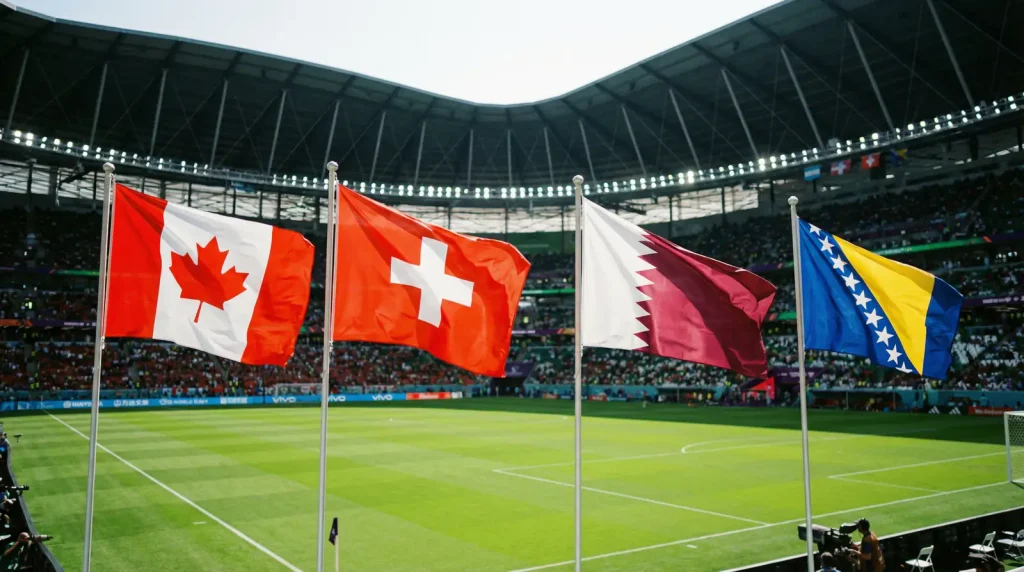
Table of Contents
Four years ago, Qatar hosted football’s biggest party and discovered hosting provides no immunity from footballing reality. The smallest nation ever to stage a World Cup finished bottom of their group with three defeats and one goal scored. Now they return to the tournament as visitors, carrying the awkward burden of proving their 2022 performance was circumstantial rather than definitive. Group B offers them a genuine opportunity for redemption, though the presence of two co-hosts seeking their own breakthrough creates a fascinating three-way battle beneath Switzerland, the clear group favourite. Canada enters as tournament co-hosts with a nation’s hopes weighing heavily, while Bosnia-Herzegovina brings the raw hunger of a country that has transformed footballing dreams into genuine competitive quality within a single generation.
Canada — Co-Hosts’ Tournament
Something remarkable has happened to Canadian football over the past decade. A country that treated soccer as an afterthought behind hockey, lacrosse, and even curling has suddenly discovered genuine passion for the beautiful game. The 2022 World Cup provided Canada’s first appearance since 1986, and while results disappointed — three defeats without scoring — the experience planted seeds now bearing fruit. Alphonso Davies has become a global superstar at Bayern Munich, and the squad surrounding him has matured significantly.
Home advantage changes everything for Canada in 2026. The tournament structure places Canadian matches in venues like BC Place and BMO Field, where passionate supporters will create atmospheres unlike anything visiting teams have experienced. Vancouver’s multicultural population brings tribal loyalties from across the globe, meaning opponents may find fewer neutral voices in the crowd than expected. Toronto’s football culture has exploded through MLS, and that enthusiasm translates directly to national team support.
The Canadian squad presents interesting tactical questions. Davies represents world-class quality at left-back and left-wing, capable of destroying opponents with his searing pace. The midfield has improved substantially, with several players now competing in Europe’s top leagues. What remains uncertain is whether enough quality exists throughout the squad to capitalise on home advantage. World Cup tournaments punish weaknesses ruthlessly, and depth concerns could emerge during a congested schedule.
From a betting perspective, Canada to finish in the top two offers reasonable value at around 4/5 (1.80 decimal). They should beat Qatar and Bosnia-Herzegovina at home, leaving the Switzerland fixture as the decisive match. Even a Switzerland defeat might not prove fatal given the expanded format — eight third-placed teams advance, and Canada’s home matches should generate sufficient goal difference for advancement. The co-host narrative carries genuine weight here.
My concern with Canada remains their lack of tournament experience. The 2022 campaign showed a team overwhelmed by the occasion, making basic errors under pressure that club football rarely produces. Whether four years of development has hardened this squad mentally remains unclear. The opening group match will reveal much about their psychological readiness for the tournament’s intensity.
Switzerland — Steady European Outfit
Twenty-two consecutive years of World Cup and European Championship participation speaks to Switzerland’s remarkable consistency. They never quite reach the tournament’s final stages, but they never miss out entirely either. This record makes them the quintessential “good team” — respectable opponents who beat lesser nations and occasionally upset favourites, but rarely mount serious challenges for trophies. Group B presents an opportunity to top a group comfortably, something Switzerland has achieved only twice in their World Cup history.
Swiss football operates on efficiency and organisation rather than individual brilliance. The squad contains several excellent players competing at top European clubs, yet none carries the global recognition of a genuine superstar. This anonymity sometimes works in their favour — opponents prepare for Switzerland’s system rather than any single threat, which can create tactical predictability but also collective strength. When everyone knows their role and executes it precisely, Swiss teams become remarkably difficult to beat.
The progression from group stage to knockout rounds has become Switzerland’s comfort zone. Five of their last six major tournaments have seen them advance from groups, with only Euro 2024 providing an exception. This consistency makes them heavy favourites to win Group B, and the market reflects that reality — odds around 4/7 (1.57 decimal) to top the group leave little room for profitable betting. What interests me more are the margins. Switzerland winning all three group matches pays around 5/2 (3.50 decimal), and against this opposition, that outcome seems plausible.
The Swiss approach to World Cup football prioritises defensive solidity over attacking adventure. Conceding first represents their nightmare scenario — chasing games has never been their strength, and the patient build-up play they prefer requires opponents to engage rather than sit deep. Both Canada and Qatar will likely attempt to frustrate Switzerland, which creates tactical challenges the Swiss have sometimes struggled to solve. Bosnia-Herzegovina presents different problems, with their direct attacking style potentially exploiting Swiss defensive vulnerabilities.
Qatar — Former Hosts, New Challenge
Hosting a World Cup should have been the pinnacle of Qatar’s football journey. Instead, it became an uncomfortable examination of the gap between financial investment and footballing reality. Three defeats, one goal scored, and an early elimination before the knockout rounds even began. The 2022 campaign raised fundamental questions about whether Qatar can compete at this level or whether their presence represents financial rather than sporting merit.
Four years provide significant time for development, and Qatar have used it wisely. The domestic league has improved, European-based players have gained experience, and the Asian Cup triumph in 2024 demonstrated genuine competitive quality within their confederation. What remains uncertain is whether Asian dominance translates to World Cup competitiveness. The gap between continental elite and global elite is substantial, and Qatar’s 2022 struggles suggest they occupy the former category rather than the latter.
Group B offers Qatar a realistic path to proving sceptics wrong. Canada’s home advantage poses significant challenges, but Switzerland and Bosnia-Herzegovina represent beatable opponents on neutral American territory. The key for Qatar lies in the opening fixture — if they can secure points early, momentum builds. A defeat in their first match would immediately invite comparisons to 2022, potentially triggering the same psychological collapse that undermined their home tournament.
Betting markets price Qatar as group outsiders at around 7/1 (8.00 decimal) to qualify, odds that feel slightly harsh given their quality within Asian football and the experience gained from hosting. The value proposition improves in specific match markets, particularly Qatar to score in all three games at around 2/1 (3.00 decimal). Their attacking players have improved substantially since 2022, and finding the net should not prove as difficult as their home tournament suggested.
Bosnia-Herzegovina
A country that barely existed in its current form thirty years ago now competes at football’s highest level. Bosnia-Herzegovina’s World Cup qualification represents one of football’s most remarkable nation-building stories, transforming sporting infrastructure and player development within a single generation. Their 2014 World Cup debut — the first major tournament since independence — remains a source of immense national pride, even though group stage elimination followed.
The current Bosnian squad lacks the star power of that 2014 generation, which included Edin Džeko at his peak. What they possess instead is collective spirit and tactical discipline developed through a competitive European qualification campaign. Playing for Bosnia carries emotional weight that transcends sporting motivation — this is a country where football provides unity across ethnic divisions that still shape daily life. Every match becomes something larger than ninety minutes of competition.
Group B presents Bosnia-Herzegovina with genuine opportunities. They need not fear any opponent here — Switzerland are respected rather than feared, Canada lack tournament pedigree, and Qatar’s 2022 struggles suggest vulnerability. The Bosnian approach typically combines physical presence with direct attacking play, a style that can trouble technically superior opponents. Set pieces represent a particular strength, with height advantages throughout the squad creating aerial threats from corners and free kicks.
I rate Bosnia-Herzegovina as live outsiders for qualification at odds around 3/1 (4.00 decimal). Their ceiling is lower than Canada’s but their floor is higher — they will not collapse psychologically regardless of circumstances. For each-way betting on group qualification, Bosnia represents attractive value. A third-place finish with four points might see them advance as one of the best runners-up, and four points from matches against Canada, Qatar, and potentially stealing something from Switzerland seems achievable.
Group B Fixtures (IST)
Scheduling Group B required FIFA to balance Canadian home advantage against worldwide television audiences. The result places most fixtures during evening hours in both North American and European time zones, creating accessible viewing windows for Irish audiences. Unlike some groups scattered across vastly different time zones, Group B concentrates in the northeastern region of the tournament footprint, meaning travel between venues remains manageable for teams.
| Date | Match | Kick-Off (IST) | Venue |
|---|---|---|---|
| 12 June 2026 | Canada vs Bosnia-Herzegovina | 20:00 | BMO Field, Toronto |
| 12 June 2026 | Switzerland vs Qatar | 23:00 | TBC |
| 17 June 2026 | Canada vs Qatar | 01:00 | BC Place, Vancouver |
| 17 June 2026 | Switzerland vs Bosnia-Herzegovina | 20:00 | TBC |
| 21 June 2026 | Canada vs Switzerland | 01:00 | BMO Field, Toronto |
| 21 June 2026 | Qatar vs Bosnia-Herzegovina | 01:00 | TBC |
The opening match between Canada and Bosnia-Herzegovina at BMO Field sets the tone for the entire group. Toronto’s football culture has developed rapidly through MLS, and the stadium atmosphere will be electric. For Bosnia, this represents their toughest fixture on paper — defeating hosts in their opening match would constitute a major upset. The 20:00 IST kickoff makes this ideal viewing for Irish audiences seeking an entertaining neutral match.
Matchday two brings the crucial Canada versus Qatar fixture, scheduled for 01:00 IST to accommodate Vancouver’s time zone. This match likely determines whether Canada’s tournament becomes a celebration or a disappointment. Victory would almost certainly secure advancement; defeat could trigger the same psychological struggles that undermined their 2022 campaign. The late kickoff requires commitment from European viewers, but the drama should reward those who stay awake.
The final matchday features simultaneous kickoffs at 01:00 IST, with Canada versus Switzerland in Toronto while Qatar face Bosnia-Herzegovina. If the group remains competitive, both matches could carry knockout implications. The Canadian media will build the Switzerland fixture into the biggest match in the country’s football history, and that pressure creates opportunity for both triumph and collapse.
Predictions & Odds
Group B follows a familiar World Cup pattern — one clear favourite, one home nation seeking breakthrough, and two outsiders with spoiler potential. Switzerland should navigate this group comfortably, their experience and quality providing edges against opposition that either lacks tournament pedigree or carries psychological baggage from recent struggles. Canada’s home advantage makes them slight favourites for second place, though the margins separating them from Qatar and Bosnia-Herzegovina remain narrow.
My predicted final standings reflect these dynamics. Switzerland finish first with seven points, their characteristic efficiency securing two victories and a draw. Canada finish second with six points, home advantage proving decisive against Qatar and Bosnia-Herzegovina while Switzerland’s quality earns them a point in Toronto. Qatar finish third with three points, beating Bosnia-Herzegovina but losing both other fixtures. Bosnia-Herzegovina finish fourth with one point, their draw against Qatar insufficient to advance.
| Team | To Win Group | To Qualify (Top 2) | To Finish 3rd |
|---|---|---|---|
| Switzerland | 4/7 (1.57) | 1/6 (1.17) | 8/1 (9.00) |
| Canada | 2/1 (3.00) | 4/6 (1.67) | 7/4 (2.75) |
| Qatar | 7/1 (8.00) | 11/4 (3.75) | 11/8 (2.38) |
| Bosnia-Herzegovina | 8/1 (9.00) | 3/1 (4.00) | 6/4 (2.50) |
Value betting opportunities cluster around the outsiders. Bosnia-Herzegovina to qualify at 3/1 represents my strongest conviction in Group B — their floor is higher than Qatar’s, and they possess the tactical tools to frustrate fancied opponents. Qatar third place at 11/8 offers poor value despite likely accuracy; the odds simply do not compensate for the risk of Bosnian upset.
Canada to win Group B at 2/1 intrigues me more than Switzerland at 4/7. Home advantage carries genuine weight in football, and Canada’s three group matches at familiar venues provide a tangible edge. If they beat Qatar and Bosnia-Herzegovina comfortably — which home crowds make likelier — the Switzerland match becomes a shootout for first place. At 2/1, that possibility warrants consideration.
Match-specific markets offer the clearest value propositions. Canada to beat Qatar with a clean sheet pays around 7/4 (2.75 decimal), and Qatar’s historical scoring struggles at World Cups support this outcome. Switzerland versus Bosnia-Herzegovina under 2.5 goals at around 10/11 (1.91 decimal) reflects both teams’ tendency toward cagey tournament football. These targeted selections often outperform broad group winner bets.
For a comprehensive look at how Group B fits into the broader World Cup 2026 group stage picture, including qualification pathways and cross-group comparisons, our dedicated hub provides essential context for serious tournament bettors.
