
Group G — Belgium, Iran, New Zealand & Egypt
 Available in US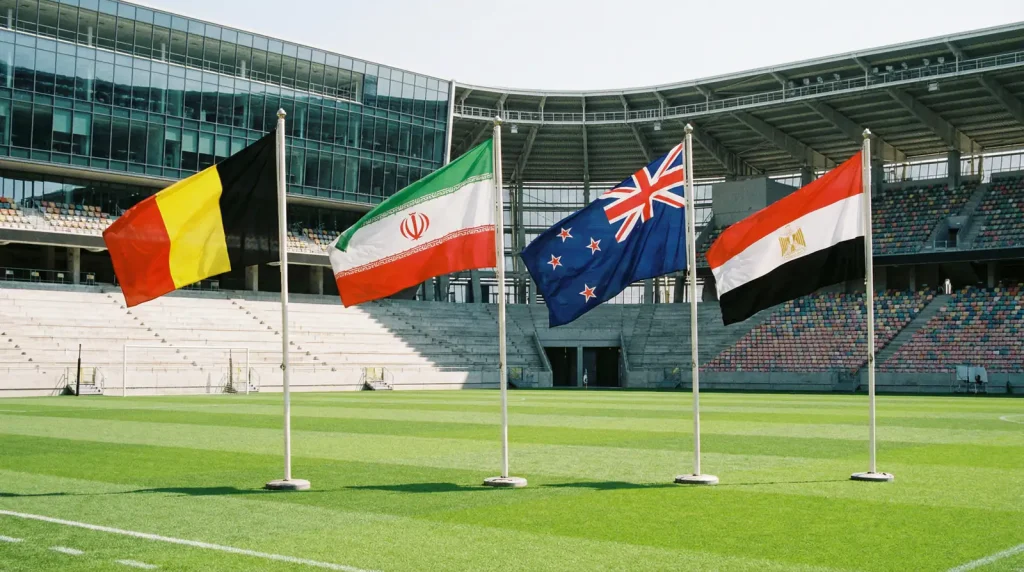
Table of Contents
Mohamed Salah carries Egyptian football on his shoulders with an intensity that borders on unfair. One player — regardless of talent — should not be expected to compensate for systemic national team limitations, yet Salah attempts exactly this every international window. Group G will test whether his individual brilliance can overcome organisational challenges that have plagued Egyptian World Cup campaigns. Belgium arrive as wounded favourites, their golden generation’s final act approaching. Iran bring controversy and quality in equal measure. New Zealand represent Oceania’s lone voice. This group combines geopolitical complexity with genuine footballing intrigue.
Belgium — Golden Generation’s Farewell Tour
I remember betting on Belgium to win the 2018 World Cup at 11/1 (12.00 decimal) before the tournament began. They finished third — an outstanding achievement that somehow felt like failure given the expectations their squad generated. Kevin De Bruyne, Eden Hazard, Romelu Lukaku, and Thibaut Courtois formed a core that should have won major silverware. Eight years later, Hazard has retired, De Bruyne approaches his final international tournaments, and the window for Belgian glory has narrowed to the point of closure.
The transition from golden generation to standard European competitor has been Belgium’s central challenge since 2022. Younger players have emerged — Jérémy Doku’s pace, Amadou Onana’s midfield presence — but none approach the quality that made Belgium world number one for extended periods. De Bruyne remains world-class when fit, though fitness has become increasingly uncertain as seasons accumulate. The question Belgium face is whether residual golden generation quality combined with adequate replacements produces knockout stage competitiveness or merely group stage survival.
Group G should present manageable opposition for Belgian ambitions. Iran, New Zealand, and Egypt each carry significant limitations that Belgian technical quality should exploit across three fixtures. Anything other than nine points and group victory would represent embarrassment given relative squad values. The concern lies not in Group G but in what follows — knockout rounds against opponents where Belgian decline becomes more apparent. For now, group dominance should be expected.
Belgium to win Group G at odds around 1/3 (1.33 decimal) offers no betting value despite high probability of occurrence. More interesting angles include Belgium team totals over 2.5 goals against New Zealand at around 4/6 (1.67 decimal), or Belgium to win to nil against Egypt at approximately 6/4 (2.50 decimal). Individual match markets provide better value than outright group positions for a team this heavily favoured. I would not oppose Belgium qualifying — that outcome approaches certainty — but finding value requires creative market selection.
Iran — Talent Meets Geopolitics
The controversy surrounding Iran’s World Cup participation dominated headlines through qualification and beyond. FIFA confirmed their participation in March 2026, resolving administrative uncertainty while leaving political tensions unaddressed. For Iranian players, the situation creates pressure that extends far beyond football — they represent a nation whose international relationships remain fraught, playing in American stadiums where significant portions of audiences may view their presence negatively. Whatever your political views, acknowledging this burden matters.
Iranian football quality has improved substantially over recent decades. The current squad features multiple players competing in European leagues, bringing technical and tactical sophistication that previous generations lacked. Their qualification campaign demonstrated consistency against Asian opponents, suggesting competitive ability that World Cup odds may undervalue. Iran understand how to make matches difficult, how to frustrate technically superior opponents, and how to seize opportunities when they arise. These qualities serve underdogs well at major tournaments.
Group G presents Iran with genuine qualification opportunities. Belgium represent clearly superior opposition, but victories against New Zealand and Egypt are achievable with proper execution. The path to second place runs through consistent performances against beatable opponents combined with a competitive showing against Belgium. Iran’s historical World Cup record — six appearances without advancing beyond the group stage — provides motivation to achieve breakthrough results. This generation possesses the quality to deliver.
Iran to qualify from Group G at odds around 5/2 (3.50 decimal) offers reasonable value given their realistic pathway. Defeating New Zealand and Egypt while taking a point from Belgium produces the five points typically required for advancement. More conservative bettors might target Iran to beat New Zealand at around 4/5 (1.80 decimal), a fixture where Iranian quality should prove decisive. I view Iran as underrated by markets still processing geopolitical narratives rather than footballing realities.
New Zealand — Oceania’s Representative
New Zealand qualified for the World Cup through a pathway that reflects football’s global expansion rather than exceptional national team quality. Oceania’s allocation — half a guaranteed spot, with playoff opportunities for more — ensures continental representation without requiring competitive strength against established footballing nations. The All Whites arrive with minimal expectations, their presence serving symbolic purposes that pure sporting merit might not justify. This is not criticism but acknowledgment of footballing reality.
The New Zealand squad combines domestic players with scattered professionals at lower European and Australian league levels. No individuals approach international class, creating collective limitations that tactical organisation cannot fully overcome. Their qualification campaign involved defeating Oceanian neighbours — Fiji, Papua New Guinea, New Caledonia — rather than competitive tests against World Cup-calibre opponents. The gap between Oceanian football and World Cup standards remains substantial, though individual performances can occasionally surprise.
Group G places New Zealand against opponents who should prove overwhelming. Belgium, Iran, and Egypt each possess technical quality that exposes New Zealand defensive limitations. The realistic ceiling involves competitive scorelines and perhaps an unexpected draw through defensive heroics, but three defeats remain the most probable outcome. For New Zealand, success means representing Oceania respectably rather than achieving advancement that geographical footballing isolation makes improbable.
New Zealand betting markets offer limited appeal given their quality ceiling. The most interesting angle might be total goals in their fixtures, with Belgian and Iranian attacking quality suggesting both teams to score in multiple matches. New Zealand +2.5 Asian handicap against Belgium at around 11/10 (2.10 decimal) provides some insurance against complete Belgian dominance, though covering three-goal margins still requires competitive performance. I would generally avoid New Zealand markets given predictable outcomes.
Egypt — Salah’s Supporting Cast
The 2018 World Cup should have been Egypt’s moment. Qualifying after decades of absence, riding Salah’s Liverpool peak, they arrived in Russia with genuine optimism. Then Salah carried a shoulder injury from Champions League final contact with Sergio Ramos, played through pain rather than peak condition, and Egypt departed without a point from three fixtures. That disappointment lingers — proof that individual brilliance cannot overcome collective inadequacy at football’s highest levels. Eight years later, the question remains whether Egypt have built sufficient support around Salah.
The honest assessment is that Egypt have not substantially improved their non-Salah quality since 2018. The squad features capable players at modest European and Middle Eastern clubs, but none who would start for World Cup favourites or even consistent knockout qualifiers. Salah must create, finish, inspire, and defend against tactical focus that opponents design specifically around neutralising him. When one player attracts that level of attention, supporting cast quality becomes decisive — and Egyptian supporting cast quality remains questionable.
Group G positioning creates both opportunity and pressure for Egypt. Belgium should prove too strong regardless of Salah’s contributions. Iran represent direct competition for second place — a fixture that likely determines Egyptian advancement or elimination. New Zealand offer winnable opponents where Salah can demonstrate his class against overmatched defenders. The pathway to qualification exists but requires Egyptian improvement beyond 2018 levels, improvement that international breaks have not clearly demonstrated.
Egypt to qualify from Group G at odds around 9/4 (3.25 decimal) represents marginal value for believers in Salah’s carrying capacity. The Iran fixture becomes decisive — Egypt versus Iran draw at around 11/4 (3.75 decimal) reflects both teams’ defensive capabilities and the tension that mutual elimination pressure creates. Salah to score in any group match at approximately 1/4 (1.25 decimal) offers near-certainty, though the price reflects that probability. Finding Egyptian betting value requires identifying specific match circumstances where their limitations are minimised.
Fixtures & Kick-Off Times (IST)
Group G fixtures include several late-night kickoffs that challenge Irish viewing schedules. Matches held in American Pacific Time zone venues begin after midnight IST, requiring commitment from those following complete group developments. The Egypt versus Iran fixture — this group’s decisive match — should receive prime scheduling that respects its significance for qualification calculations.
| Date | Match | Kick-Off (IST) | Venue |
|---|---|---|---|
| 16 June 2026 | Belgium vs New Zealand | 20:00 | TBC |
| 16 June 2026 | Iran vs Egypt | 23:00 | TBC |
| 21 June 2026 | Belgium vs Iran | 17:00 | TBC |
| 21 June 2026 | Egypt vs New Zealand | 20:00 | TBC |
| 25 June 2026 | Belgium vs Egypt | 23:00 | TBC |
| 25 June 2026 | Iran vs New Zealand | 23:00 | TBC |
Opening matchday immediately establishes Group G stakes. Belgium versus New Zealand at 20:00 IST should confirm Belgian dominance with comfortable victory. The later Iran versus Egypt at 23:00 IST represents the group’s most significant fixture from a qualification perspective — whoever wins gains decisive advantage in the chase for second place, while a draw keeps both teams’ hopes alive but dependent on subsequent results. This opening fixture deserves viewing priority despite its late scheduling.
Matchday two brings Belgium versus Iran at 17:00 IST — accessible afternoon viewing for Irish audiences. Iranian quality will be properly tested against European elite, with competitive performance demonstrating genuine capability regardless of result. Egypt versus New Zealand at 20:00 IST should see Salah dominate inferior opposition, potentially boosting goal difference that becomes crucial in tightly contested group standings. Both fixtures should clarify hierarchies established on opening day.
Final matchday kickoffs at 23:00 IST require late viewing but could prove decisive for qualification. Belgium versus Egypt should see the Belgians complete group victory while potentially being affected by rotation. Iran versus New Zealand offers Iran’s best opportunity for comfortable victory and goal difference improvement. By this stage, qualification scenarios should be clear, with final fixtures confirming rather than dramatically altering group outcomes.
Predictions & Odds
Group G hierarchy appears relatively straightforward despite competitive elements. Belgium should dominate, their technical quality overwhelming opponents regardless of golden generation decline. Iran and Egypt will contest second place, with Iranian consistency likely proving decisive against Egyptian over-reliance on Salah. New Zealand complete the group without points but hopefully with respectability intact.
My predicted final standings: Belgium first with nine points from three comfortable victories. Iran second with six points, defeating New Zealand and Egypt while losing competitively to Belgium. Egypt third with three points, their victory over New Zealand insufficient when combined with defeats to Belgium and Iran. New Zealand fourth with zero points, outclassed across three fixtures but competitive in individual periods.
| Team | To Win Group | To Qualify (Top 2) | To Finish 3rd |
|---|---|---|---|
| Belgium | 1/3 (1.33) | 1/12 (1.08) | 14/1 (15.00) |
| Iran | 4/1 (5.00) | 5/2 (3.50) | 5/4 (2.25) |
| Egypt | 5/1 (6.00) | 9/4 (3.25) | 11/10 (2.10) |
| New Zealand | 66/1 (67.00) | 25/1 (26.00) | 4/1 (5.00) |
Iran to qualify at 5/2 (3.50 decimal) represents my primary value selection in Group G. Their quality exceeds market pricing, their pathway to second place is achievable, and their opening fixture against Egypt positions them favourably. I view Iran as underrated by odds that still process non-footballing considerations ahead of squad analysis. Egypt’s Salah dependency creates vulnerability that Iran’s collective organisation can exploit.
Belgium match markets offer better value than group positions. Belgium over 2.5 goals against New Zealand at around 4/6 (1.67 decimal) should land comfortably. Belgium to win to nil against any opponent provides consistent value given defensive quality differentials. Avoid backing Belgium at short prices for group victory — the outcome is probable but the odds offer no edge.
For comprehensive group stage analysis including knockout pathway implications from Group G, our World Cup 2026 groups hub provides the broader tournament context that informs serious betting decisions.
