
Messi World Cup 2026 Final — Farewell, Silver Ball & Lost Records
 Available in US
Table of Contents
- The Final: Argentina 0-1 Spain
- Messi’s Last World Cup: Widely Reported at 39
- Silver Ball: Second-Best Player of the Tournament
- Golden Boot Race: Held Scoreless, Finished on 8 Goals
- All-Time Goals Record: Overtaken by Mbappé
- Records That Stand: Appearances and Assists
- Tournament Performance: 8 Goals, 4 Assists, Silver Ball
- The Guard of Honour and Post-Match Scenes
- Market Outcome: Golden Ball Favourite at 1.11 Lost
- Legacy: Six World Cups, One Title, No Golden Boot
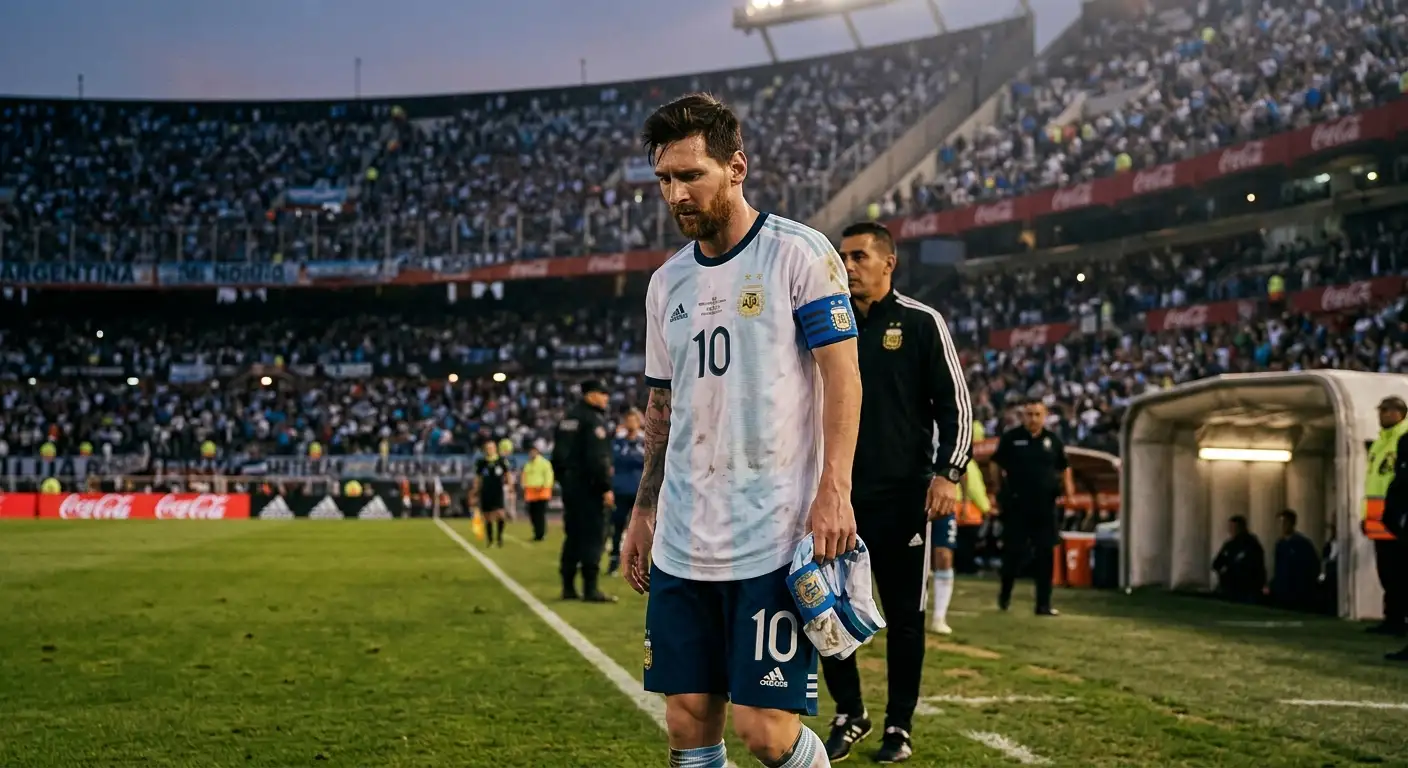
Lionel Messi after Argentina’s 1-0 defeat to Spain in the 2026 World Cup final — widely reported as his final World Cup match at 39 years old.
Lionel Messi’s sixth and final World Cup ended in defeat on 19 July 2026, as Argentina lost 1-0 to Spain in extra time at MetLife Stadium. The 39-year-old was held scoreless across 120 minutes, finishing the tournament with the Silver Ball but losing both the Golden Boot and the all-time World Cup goals record to Kylian Mbappé. Spain formed a guard of honour as Messi collected his runners-up medal, with the Argentine captain reportedly in tears as his international career reached its end.
The Final: Argentina 0-1 Spain
Argentina’s bid for back-to-back World Cup titles fell short in the final on 19 July 2026, losing 1-0 to Spain after extra time. The match was scoreless through 90 minutes before Ferran Torres struck in the 106th minute, combining with substitute Nico Williams to deliver Spain’s second World Cup title and deny Argentina a repeat of their 2022 triumph.
Messi played the full 120 minutes but was unable to break through Spain’s defence, which conceded just one goal across eight matches. Argentina struggled to create clear chances against Spain’s back line — anchored by Pau Cubarsí and Aymeric Laporte — with Messi limited to long-range efforts and set-piece situations. Unai Simón, Spain’s goalkeeper, faced minimal threat and secured his seventh clean sheet of the tournament.
Argentina were reduced to 10 men in stoppage time when Enzo Fernández received a second yellow card (90+3′) for a reckless foul on Cubarsí, leaving them to play the entirety of extra time a man down. The numerical disadvantage compounded Argentina’s inability to create chances, and Spain controlled possession through the additional 30 minutes.
Emiliano Martínez made 11 saves — the most ever recorded by a goalkeeper in a World Cup final — but could not prevent Torres’s winner. The defeat ended Argentina’s hopes of becoming the first team to win consecutive World Cups since Brazil in 1958 and 1962, and marked Messi’s final appearance on the World Cup stage.
Messi’s Last World Cup: Widely Reported at 39
The 2026 final is widely reported as Messi’s last World Cup match, with the 39-year-old confirming in post-match interviews that his international tournament career has concluded. Messi had previously stated that the 2022 World Cup in Qatar would be his last, only to reverse that decision and participate in 2026 — but the finality of the 19 July defeat appears to have brought closure.
Multiple outlets reported Messi in tears during the medal ceremony, with Spain’s players forming a guard of honour as he collected his runners-up medal. The gesture was returned by Argentina’s squad during Spain’s trophy lift, though reports noted that several Argentina players turned away and did not return the honour in full — a moment that drew criticism from pundits and observers.
Messi’s six World Cup campaigns spanned two decades, from his debut as a substitute in 2006 to the 2026 final. The 2026 tournament brought his World Cup appearances record to 28 matches, extending his own mark, and took his career goals tally to 21 — a record that stood until Kylian Mbappé’s bronze-match brace on 18 July pushed him to 22.
Argentina coach Lionel Scaloni praised Messi in his post-match press conference, stating: "He’s 39 years old, it’s an incredible thing. … In my opinion, he’s the best footballer to ever step onto a football pitch." Scaloni confirmed he would remain as Argentina coach but offered no clarity on Messi’s international future beyond the World Cup, with Copa América participation left open.
The final marked the end of Messi’s pursuit of a second World Cup title, having won in 2022 and reached the final again in 2026. The defeat, and the individual awards that went elsewhere — Rodri’s Golden Ball, Mbappé’s Golden Boot — closed a chapter that had defined international football for 20 years.
Silver Ball: Second-Best Player of the Tournament
Messi was awarded the Silver Ball as the tournament’s second-best player, finishing behind Spain’s Rodri (Golden Ball) and ahead of Kylian Mbappé (Bronze Ball). The award recognised Messi’s 8 goals and 4 assists across seven matches, including a hat-trick in the semi-final against England, but acknowledged that Rodri’s midfield dominance had anchored Spain’s title run.
The Silver Ball was the one individual award Messi secured at the 2026 World Cup, having entered the final as the heavy favourite for the Golden Ball (priced at approximately 1.11, or 1/9 in fractional terms). The market had expected Messi to cap his tournament with the top individual honour, but the final defeat — and his scoreless performance across 120 minutes — shifted the award to Rodri, who had captained Spain’s defence and midfield throughout the knockout rounds.
The Golden Ball podium — Rodri, Messi, Mbappé — reflected the tournament’s narrative hierarchy: Spain’s collective triumph, Argentina’s near-miss, and France’s individual brilliance in a fourth-place finish. Messi’s placement ahead of Mbappé (who won the Golden Boot and set the all-time goals record) indicated that the voting panel valued Argentina’s final appearance over France’s semi-final exit, despite Mbappé’s superior goal tally.
The Silver Ball was Messi’s second career podium finish in the award, having won the Golden Ball in 2014 (Argentina runners-up) and again in 2022 (Argentina winners). The 2026 Silver Ball thus marked a step down from his 2022 triumph, but the recognition as the tournament’s second-best player at 39 years old underscored his continued influence on Argentina’s attack.
The award ceremony on 19 July saw Messi collect the Silver Ball trophy alongside his runners-up medal, with Spain’s guard of honour forming a backdrop. The juxtaposition — Messi receiving individual recognition whilst Spain lifted the World Cup — framed the tournament’s central tension: Argentina had the tournament’s second-best player, but Spain had the better team.
Golden Boot Race: Held Scoreless, Finished on 8 Goals
Messi finished the 2026 World Cup with 8 goals, two behind Golden Boot winner Kylian Mbappé (10 goals). The final on 19 July offered Messi one last chance to overtake Mbappé, but he was held scoreless across 120 minutes, sealing the Golden Boot for the Frenchman and ending Messi’s pursuit of the award.
Messi had entered the final on 8 goals, having scored a hat-trick in Argentina’s 2-1 semi-final win over England on 15 July. The treble took him level with Mbappé at 8 goals, but Mbappé’s bronze-match brace on 18 July (France lost 6-4 to England) pushed him to 10 and effectively settled the race. For Messi to win the Golden Boot, he would have needed to score three times in the final — an unrealistic target against Spain’s defence, which had conceded just one goal across seven matches.
The final confirmed the Golden Boot outcome. Messi was tightly marked by Spain’s midfield and back line across 120 minutes. Argentina’s attacking plan struggled to create clear chances, with Emiliano Martínez’s 11 saves at the other end highlighting the one-sided nature of the contest. The scoreless performance left Messi on 8 goals, two behind Mbappé and three ahead of joint-third-placed Erling Haaland and Jude Bellingham (7 each).
The Golden Boot market had reflected the two-goal deficit, pricing Messi at approximately 13.0 before the final — long odds that acknowledged Mbappé’s cushion and the difficulty of scoring multiple goals against Spain. The 1.04 favourite price on Mbappé proved accurate, with the award settled before the final kicked off.
Messi’s 8-goal haul was his best at a single World Cup, surpassing his 4 goals in 2014 (Argentina runners-up) and his 7 goals in 2022 (Argentina winners). The total placed him second in the 2026 Golden Boot standings, a creditable finish at 39 years old, but the two-goal margin to Mbappé meant the award — which had eluded Messi across six World Cups — remained out of reach.
All-Time Goals Record: Overtaken by Mbappé
Messi’s all-time World Cup goals record stood at 21 after the 2026 tournament, having been overtaken by Kylian Mbappé’s 22 following the bronze match on 18 July. The record had changed hands during the knockout rounds, with Messi briefly tying Miroslav Klose’s long-standing mark of 16 goals before both Messi and Mbappé surpassed it.
Messi had entered the 2026 tournament on 13 career World Cup goals, adding 8 at the 2026 edition to reach 21. The semi-final hat-trick against England on 15 July took him to 21 and momentarily placed him ahead of Mbappé (then on 20), but Mbappé’s two goals in the bronze match on 18 July pushed him to 22, reclaiming the record.
The final on 19 July was Messi’s last opportunity to retake the record, but he was held scoreless across 120 minutes. Mbappé, having played the previous day in the bronze match, could not add to his tally, leaving the all-time record at Mbappé 22, Messi 21 — a one-goal margin that reflected the timing of the bronze match and Messi’s inability to score in the final.
The record had been a symbolic marker throughout the tournament, with Messi’s pursuit framed as a final chapter in his World Cup career. The hat-trick against England briefly suggested he might finish as the all-time leader, but Mbappé’s response in the bronze match — and Messi’s scoreless final — settled the record in Mbappé’s favour.
Messi’s 21 goals came across six World Cups (2006, 2010, 2014, 2018, 2022, 2026), a span of 20 years and 28 matches. Mbappé’s 22 goals came across three tournaments (2018, 2022, 2026), 22 matches, and at a younger age (27 vs Messi’s 39). The efficiency difference — Mbappé’s 1.0 goals-per-game average vs Messi’s 0.75 — underscored the generational shift, with Mbappé now holding the record Messi had briefly claimed.
Records That Stand: Appearances and Assists
Whilst Messi lost the all-time goals record to Mbappé, he retains two other all-time World Cup records that remain unchallenged: most appearances (28) and most assists (12).
The appearances record was extended at the 2026 tournament, with Messi playing in all seven of Argentina’s matches (group stage through to the final). The 28 total appearances span six World Cups from 2006 to 2026, surpassing Lothar Matthäus’s previous record of 25 matches. The longevity required to reach 28 appearances — playing deep into six tournaments across four different decades — is unlikely to be matched in the near future, given the physical demands of modern football and the rarity of players maintaining elite form into their late 30s.
The assists record of 12 is the all-time career mark, distinct from Michael Olise’s single-tournament record of 7 assists at the 2026 World Cup. Messi’s 12 assists came across the same six tournaments, including 4 assists at the 2026 edition. The record surpassed Pelé’s previous mark of 10 assists, and Messi extended it with key passes in both the group stage and knockout rounds of the 2026 tournament.
Messi also holds the record for most World Cup minutes played, having accumulated over 2,300 minutes across 28 matches. The minutes record is a function of the appearances total and Messi’s tendency to play full matches, particularly in knockout rounds where Argentina often required extra time (as in the 2026 final).
These records — appearances, assists, and minutes — form Messi’s enduring World Cup legacy alongside the 21 career goals and the 2022 title. The all-time goals record may have moved to Mbappé, but the longevity markers remain Messi’s, reflecting two decades of sustained excellence at the highest level of international football.
Tournament Performance: 8 Goals, 4 Assists, Silver Ball
Messi’s 2026 World Cup campaign produced 8 goals and 4 assists across seven matches, placing him second in the Golden Boot race and earning the Silver Ball as the tournament’s second-best player. The statistical output was Messi’s best at a single World Cup, surpassing his 7 goals and 3 assists at the 2022 tournament (where he won the Golden Ball).
The 8 goals came in a variety of situations: group-stage penalties, knockout-round headers, and the decisive hat-trick in the semi-final against England on 15 July. The treble against England was Messi’s first World Cup hat-trick, taking his tournament tally to 8 and briefly placing him level with Mbappé in the Golden Boot race. The semi-final performance — 3 goals in a 2-1 win that sent Argentina to the final — was widely described as one of Messi’s finest World Cup displays.
The 4 assists included key passes in the group stage (to Julián Álvarez and Nicolás González) and knockout rounds, with Messi dropping deeper in several matches to link midfield and attack. The dual threat — goalscoring and chance creation — underpinned Argentina’s run to the final, even as the scoreless final performance highlighted the limits of individual brilliance against Spain’s collective organisation.
Messi’s tournament average of 1.14 goals per match (8 in 7 games) was the highest of his World Cup career, ahead of his 2014 (4 in 7, 0.57 per match) and 2022 (7 in 7, 1.0 per match) campaigns. The improvement in conversion rate reflected Argentina’s tactical setup, which positioned Messi as the focal point of the attack and prioritised his shooting opportunities in the penalty area.
The Silver Ball recognised the cumulative output — 8 goals, 4 assists, 7 matches, runners-up finish — whilst acknowledging that Rodri’s midfield control had been the tournament’s defining individual contribution. The award placed Messi ahead of Mbappé (Bronze Ball, 10 goals, fourth place) and the rest of the tournament’s standout performers, but behind the Golden Ball winner.
The Guard of Honour and Post-Match Scenes
The medal ceremony on 19 July 2026 at MetLife Stadium included a guard of honour from Spain’s players as Messi and Argentina collected their runners-up medals. The gesture was widely noted in post-match coverage, with Spain’s squad applauding as Messi — reportedly in tears — walked through to receive his medal from FIFA officials.
The guard of honour was intended as a mark of respect for Messi’s career and his final World Cup appearance, and it was reciprocated by Argentina’s players during Spain’s trophy lift. However, reports noted that several Argentina players turned away during Spain’s celebration and did not fully return the honour, a moment that drew criticism from pundits and observers who viewed it as poor sportsmanship.
BBC pundit Alan Shearer commented on the post-match scenes, particularly the altercation involving Leandro Paredes, who grabbed Spain’s Eric García by the throat seconds after the final whistle. Shearer stated: "Paredes threw two or three haymakers into someone’s face. He went for them." The incident — triggered by Cristian Romero confronting Rodri, with García stepping in — overshadowed the initial sportsmanship of the medal ceremony and became a focal point of post-match analysis.
Messi himself was not involved in the altercation, walking directly to the medal ceremony and speaking briefly with Spain’s coaching staff. His post-match interview reflected the defeat, stating: "I feel sad, but I am aware that we played our hearts out. … They were better, to be honest. We lost the game, and we accept that." The tone was subdued, acknowledging Spain’s superiority and framing the defeat as the end of his World Cup journey.
The guard of honour and the surrounding scenes captured the duality of the final: respect for Messi’s legacy, and the raw emotion of Argentina’s defeat. Spain’s gesture was widely praised, whilst the post-whistle altercation and Argentina’s partial reciprocation drew criticism, complicating the narrative of Messi’s farewell.
Market Outcome: Golden Ball Favourite at 1.11 Lost
Messi had been the Golden Ball favourite at approximately 1.11 (around 1/9 in fractional terms) heading into the final on 19 July 2026, but the award went to Spain’s Rodri, who had been priced at approximately 11.0 (+1000) — making the Golden Ball the tournament’s biggest market upset.
The pre-final pricing had assumed that Argentina’s appearance in the final, combined with Messi’s 8 goals and 4 assists, would secure the top individual honour regardless of the match result. Historical precedent supported this: the Golden Ball often goes to a player from the finalists, and Messi’s statistical output placed him ahead of Rodri in goals and assists. The 1.11 favourite price reflected near-certainty, with the market viewing the award as Messi’s to lose.
The final changed the calculus. Messi’s scoreless performance across 120 minutes — Argentina struggled to create attacking opportunities — contrasted with Rodri’s composed midfield display, anchoring Spain’s possession and defensive structure. The 1-0 victory, Spain’s eighth win in eight matches, reinforced the narrative of collective superiority, and Rodri’s role as captain and midfield organiser became the focal point of post-match analysis.
The Golden Ball result — Rodri over Messi — was the tournament’s most unexpected individual outcome, comparable to a 10.0 longshot winning a knockout match. For Irish punters, the fractional equivalent of 11.0 (10/1) represented a significant value opportunity, though few would have backed against a 1.11 favourite in the Golden Ball market. The settlement defied conventional wisdom and highlighted the importance of the final match in determining individual awards.
The market outcome left Messi with the Silver Ball and no Golden Boot, despite entering the final as the favourite for the former and a contender for the latter. The dual disappointment — losing both individual awards and the World Cup — framed the narrative of Messi’s 2026 tournament as a near-miss across all three dimensions.
Legacy: Six World Cups, One Title, No Golden Boot
Messi’s World Cup career spanned six tournaments from 2006 to 2026, producing one title (2022), two runners-up finishes (2014, 2026), 21 career goals, 12 career assists, 28 appearances, and one Golden Ball (2014). The 2026 final marked the end of a two-decade journey that defined international football but left several individual milestones unclaimed.
The 2022 title remains the apex of Messi’s World Cup legacy, Argentina defeating France on penalties after a 3-3 draw in which Messi scored twice. The triumph completed the one gap in Messi’s career honours, silencing critics who had questioned his ability to deliver at the World Cup after the 2014 final defeat to Germany. The 2026 final, by contrast, represented a return to the runner-up position, with Spain’s 1-0 win denying Argentina back-to-back titles.
The Golden Boot eluded Messi across all six tournaments, despite finishing as runner-up twice (2022: 7 goals behind Mbappé’s 8; 2026: 8 goals behind Mbappé’s 10). The closest Messi came was in 2014, when he scored 4 goals and won the Golden Ball, but the Golden Boot went to James Rodríguez (6 goals). The failure to claim the award, despite 21 career goals, reflects the competitive depth of World Cup scoring races and Messi’s tendency to peak in knockout rounds rather than accumulating group-stage tallies.
The all-time goals record slipped away in the final days of the 2026 tournament, with Mbappé’s bronze-match brace on 18 July pushing him to 22 goals and past Messi’s 21. Messi had held the record outright for less than 48 hours, following his semi-final hat-trick on 15 July, before Mbappé reclaimed it. The scoreless final on 19 July confirmed the record would remain with Mbappé.
Messi’s World Cup legacy is thus defined by longevity, consistency, and the 2022 title, balanced against the individual awards that went to others. The 2026 final — a defeat, a Silver Ball, and the loss of two records — closed the chapter on a career that reshaped expectations of individual brilliance at the World Cup.
Betting Opportunities: Spinstar.bet, WinRolla, and RichRoyal offer settled markets on individual awards and future tournament specials. Review odds formats and value bets for the 2030 World Cup cycle.
Related Pages:
- World Cup 2026 Odds — Outright winner, Golden Ball, and Golden Boot markets
- Argentina World Cup 2026 — Argentina’s campaign, squad, and results
- Top Scorer Golden Boot Odds — Historical Golden Boot winners
- World Cup 2026 Betting Guide — Tournament betting strategies
