
Spain Defence World Cup 2026 — 1 Goal Conceded, Simón Record
 Available in US
Table of Contents
- One Goal Conceded: Fewest by Any World Cup Winner
- Seven Clean Sheets in Eight Matches
- Unai Simón: Golden Glove and Three Distinct Records
- The Final: Defensive Dominance Against Argentina
- Defensive Structure: Cubarsí, Laporte, and Rodri
- The Single Goal Conceded: Belgium Quarter-Final
- Match-by-Match Defensive Record
- Historical Context: Fewest Goals Conceded by a Champion
- Simón’s Quote: “My Team-Mates Deserve the Credit”
- Legacy: Record Defence in the 48-Team Format
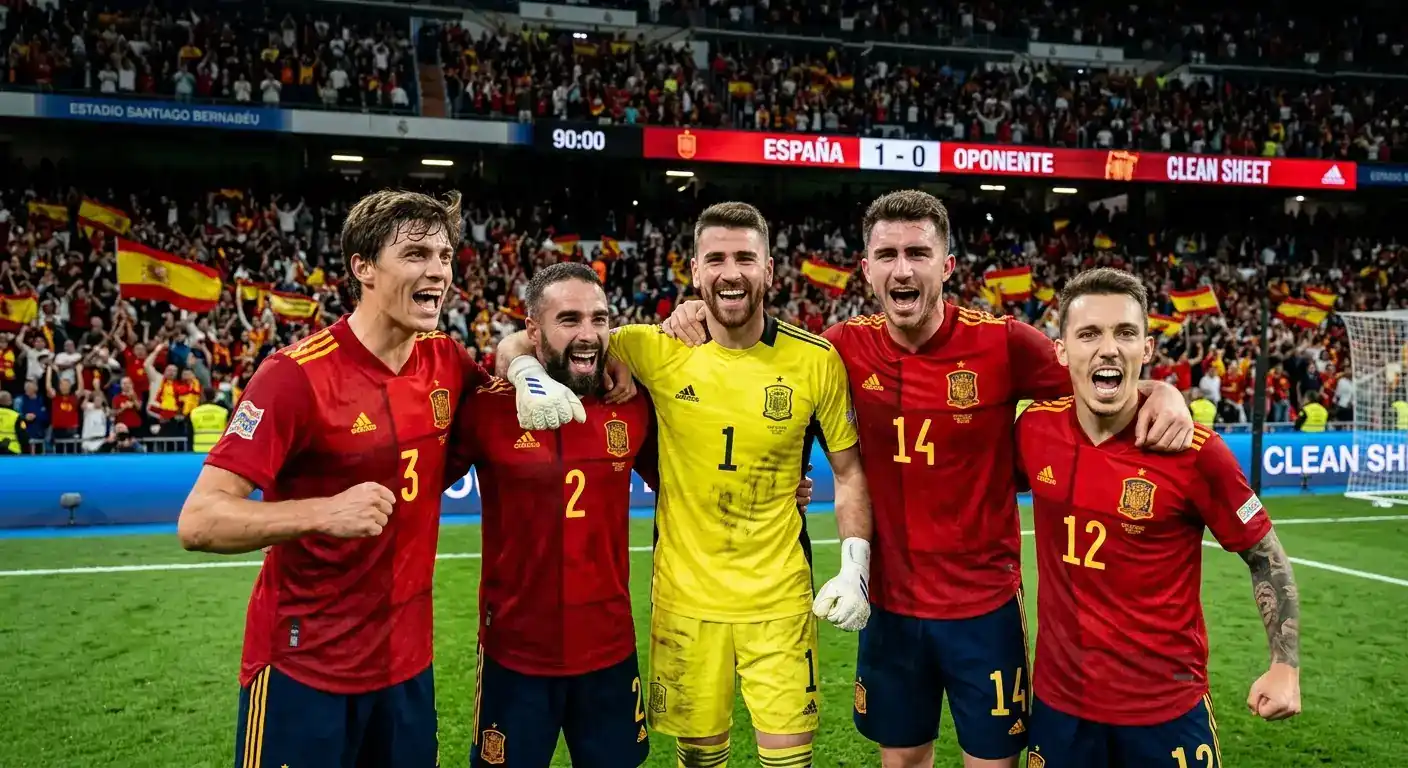
Unai Simón and Spain’s defence during the 2026 World Cup, where they conceded just 1 goal in 8 matches — the fewest by any World Cup winner.
Spain’s defence at the 2026 World Cup produced the most dominant statistical performance in tournament history, conceding just 1 goal in 8 matches — the fewest by any World Cup champion across 96 years of the competition. Unai Simón secured the Golden Glove with 7 clean sheets, setting records for both single-tournament and cross-tournament shutouts, whilst Spain’s back line limited Argentina to minimal attacking threat across 120 minutes in the final on 19 July 2026.
One Goal Conceded: Fewest by Any World Cup Winner
Spain conceded 1 goal in 8 matches at the 2026 World Cup, establishing a new record for the fewest goals conceded by a World Cup winner. The previous low was 2 goals, shared by Italy (1938) and Brazil (1994, 2002), though those champions played fewer matches under the smaller tournament formats (16 and 32 teams respectively).
The single goal came in the quarter-final against Belgium on 10 July 2026, when Belgium’s Jérémy Doku scored in the 78th minute of a 2-1 Spain victory. Spain’s clean sheets across the other seven matches — group stage wins over Cape Verde, Saudi Arabia, and Uruguay; knockout victories over Austria (Round of 32), Portugal (Round of 16), and France (semi-final); and the final against Argentina — built a defensive wall that no other team could breach.
The record is particularly notable given the 48-team format introduced at the 2026 World Cup, which expanded the tournament to 104 matches and required champions to play eight matches (up from seven in the 32-team format). Spain navigated the longer path whilst maintaining defensive integrity against progressively stronger opponents, culminating in a dominant defensive performance in the final against Argentina across 120 minutes.
The defensive record underpinned Spain’s title run, complementing the attacking contributions of Lamine Yamal, Mikel Oyarzabal, and Dani Olmo. Whilst Spain’s midfield control and possession dominance limited opponents’ chances, the back line — anchored by Pau Cubarsí and Aymeric Laporte — and Unai Simón’s goalkeeping provided the foundation for the defensive shutdown.
Seven Clean Sheets in Eight Matches
Unai Simón recorded 7 clean sheets at the 2026 World Cup, breaking the previous single-tournament record of 5 (held by Fabien Barthez in 1998 and several others). The seven shutouts came in Spain’s group-stage matches against Cape Verde (3-0), Saudi Arabia (2-0), and Uruguay (1-0); knockout wins over Austria (3-0), Portugal (1-0), and France (2-0); and the final against Argentina (1-0 after extra time).
The single match in which Spain conceded was the quarter-final against Belgium on 10 July, when Jérémy Doku scored in the 78th minute to make it 2-1. Spain had led 2-0 before the goal, and the Belgium strike ended Simón’s consecutive clean sheets streak at six matches (spanning from the group stage through the Round of 16). Spain held on to win 2-1, and Simón did not concede again in the semi-final or final.
The seven clean sheets represented 87.5% of Spain’s matches at the tournament, the highest clean-sheet percentage by any World Cup winner. The statistic reflects both Simón’s goalkeeping and Spain’s defensive organisation, which limited opponents to low-quality chances and restricted access to the penalty area.
Simón’s clean-sheet record at the 2026 tournament was set against the semi-final on 14 July, when Spain beat France 2-0 — the sixth shutout broke the previous record of 5. The seventh clean sheet in the final against Argentina extended the new mark, leaving Simón as the only goalkeeper to record seven World Cup clean sheets in a single tournament.
Unai Simón: Golden Glove and Three Distinct Records
Unai Simón won the Golden Glove as the tournament’s best goalkeeper, securing the award as a heavy favourite (priced at approximately 1.13, or around 1/8 in fractional terms). The award recognised three distinct records set across the 2026 tournament and Spain’s cross-tournament defensive run from 2022 to 2026.
Record 1: Seven Clean Sheets in a Single Tournament (2026)
Simón’s 7 clean sheets at the 2026 World Cup broke the 96-year record of 5, previously held by Fabien Barthez (France, 1998), Iker Casillas (Spain, 2010), and Manuel Neuer (Germany, 2014). The seventh clean sheet came in the final against Argentina on 19 July, cementing the record in Spain’s 1-0 win.
Record 2: Six Consecutive Clean Sheets Across Tournaments (2022-2026)
Simón’s 6 consecutive World Cup clean sheets spanned two tournaments, starting with Spain’s final group-stage match at the 2022 World Cup and continuing through the first six matches of the 2026 tournament. The streak was the first of its kind — no goalkeeper had previously recorded six consecutive World Cup shutouts across multiple editions.
The streak ended when Belgium’s Jérémy Doku scored in the 78th minute of the quarter-final on 10 July 2026. Simón then recorded two more clean sheets in the semi-final and final, but the cross-tournament record stood at six consecutive.
Record 3: 650 Consecutive Minutes Without Conceding (Cross-Tournament)
Simón’s 650 consecutive minutes without conceding across the 2022 and 2026 World Cups broke the previous record of 517 minutes, set by Italy’s Walter Zenga at the 1990 World Cup. The 650-minute streak began in the 2022 group stage and ran through to the 78th minute of the 2026 quarter-final, when Doku’s goal ended it.
The 650-minute figure is the cross-tournament record. Within the 2026 tournament alone, Simón recorded approximately 489 consecutive minutes from the start of the group stage to the Belgium goal — 28 minutes short of Zenga’s single-tournament mark of 517, which remains the record for a single World Cup edition.
Simón’s post-tournament quote acknowledged the collective effort behind the records: "If my gloves during the World Cup could talk, they would say that they haven’t had to work as much as those of other goalkeepers’. Leaving seven clean sheets are numbers that are going to cost a lot to overcome and I don’t attribute the merit to myself but to my team-mates."
The Final: Defensive Dominance Against Argentina
Spain’s defensive dominance reached its apex in the final on 19 July 2026, when Argentina were restricted to minimal attacking threat across 120 minutes. Spain’s ability to neutralise Lionel Messi and Argentina’s attack came through a combination of midfield pressure, back-line organisation, and Unai Simón’s positioning.
Argentina managed possession in patches but could not translate it into clear chances. Messi was tightly marked by Spain’s midfield, particularly Rodri and Fabián Ruiz, who denied him space in the penalty area. Argentina’s wide players — Nicolás González and Julián Álvarez — were similarly restricted, with Pedro Porro and Alejandro Cucurella limiting their ability to deliver crosses or cut inside.
Emiliano Martínez, Argentina’s goalkeeper, made 11 saves at the other end — the most by any goalkeeper in a World Cup final — highlighting the one-sided nature of the contest. Spain’s attacking pressure pinned Argentina back for extended periods, and the numerical advantage after Enzo Fernández’s red card (90+3′) compounded Argentina’s inability to mount sustained attacks in extra time.
Spain’s defensive structure — anchored by Pau Cubarsí and Aymeric Laporte, with Rodri screening — denied Argentina the space to operate, and Simón’s clean sheet in the final secured his seventh of the tournament.
The final performance encapsulated Spain’s defensive identity at the 2026 World Cup: control possession, limit opponents to low-quality chances, and maintain shape across all phases of play. The 1-0 scoreline, decided by Ferran Torres’s goal in the 106th minute, was built on the foundation of Spain’s dominant defence.
Defensive Structure: Cubarsí, Laporte, and Rodri
Spain’s defensive record was anchored by a back line featuring Pau Cubarsí (19 years old, Best Young Player), Aymeric Laporte (30, experienced centre-back), Pedro Porro (right-back), and Alejandro Cucurella (left-back), with Rodri screening as the defensive midfielder. The structure held across eight matches, with minimal rotation and a clear understanding of roles.
Cubarsí, the Barcelona teenager, was the breakout defensive performer of the tournament. His composure on the ball, reading of the game, and ability to step into midfield to intercept passes drew comparisons to a young Sergio Ramos, and his partnership with Laporte provided the solidity Spain needed against top attackers like Cristiano Ronaldo (Portugal), Kylian Mbappé (France), and Lionel Messi (Argentina). Cubarsí’s performance earned him the Best Young Player award, the first defender to win the honour since 2006.
Laporte, Spain’s senior centre-back, brought experience and aerial dominance. His positioning in the penalty area neutralised target-man strikers, and his distribution from the back initiated Spain’s build-up play. Laporte’s partnership with Cubarsí — youth and experience — was noted by analysts as one of the tournament’s most effective defensive pairings.
Rodri, Spain’s captain and Golden Ball winner, operated as the defensive midfielder, shielding the back line and breaking up opposition attacks. His tournament-record 756 completed passes (the most by any player at a single World Cup) included numerous interceptions and recoveries in Spain’s defensive third. Rodri’s ability to win possession and transition into attack was central to Spain’s control of matches, and his defensive contributions — particularly in the semi-final against France and the final against Argentina — were as important as his midfield dominance.
Porro and Cucurella, Spain’s full-backs, provided width in attack whilst maintaining defensive discipline. Porro’s delivery created the assist for Ferran Torres’s winning goal in the final, whilst Cucurella’s recovery runs and one-on-one defending limited opposition wingers. The full-backs’ ability to balance attacking contributions with defensive responsibilities allowed Spain to press high without leaving gaps at the back.
The Single Goal Conceded: Belgium Quarter-Final
The only goal Spain conceded at the 2026 World Cup came in the quarter-final against Belgium on 10 July 2026 at Hard Rock Stadium in Miami. Belgium’s Jérémy Doku scored in the 78th minute, cutting Spain’s lead to 2-1 after Spain had dominated the match and led 2-0.
The goal came from a Belgium counter-attack, with Doku receiving the ball on the left wing, cutting inside past Pedro Porro, and firing a low shot past Unai Simón’s near post. The strike was Belgium’s first shot on target in the match, highlighting the efficiency of the goal against the run of play. Spain had controlled possession and limited Belgium to speculative long-range efforts before the Doku goal briefly reopened the contest.
Spain held on to win 2-1, with the back line tightening after the goal to prevent Belgium from equalising. The concession ended Simón’s clean-sheet streak at six matches (spanning from the group stage through the Round of 16) and his consecutive minutes without conceding at 650 (cross-tournament, including the 2022 World Cup).
The Belgium goal was the only time Spain’s defence was breached across eight matches, and it remains a statistical outlier in a tournament where Spain otherwise dominated defensively. Belgium’s attack — featuring Kevin De Bruyne and Romelu Lukaku alongside Doku — managed just one goal from limited opportunities, and Spain’s ability to absorb the setback and maintain their lead demonstrated the resilience of the defensive unit.
Match-by-Match Defensive Record
Spain’s eight matches at the 2026 World Cup produced the following defensive record:
| Match | Opponent | Score | Goals Conceded | Clean Sheet |
|---|---|---|---|---|
| Group H | Cape Verde | 3-0 | 0 | Clean sheet |
| Group H | Saudi Arabia | 2-0 | 0 | Clean sheet |
| Group H | Uruguay | 1-0 | 0 | Clean sheet |
| Round of 32 | Austria | 3-0 | 0 | Clean sheet |
| Round of 16 | Portugal | 1-0 | 0 | Clean sheet |
| Quarter-final | Belgium | 2-1 | 1 (Doku 78′) | Goal conceded |
| Semi-final | France | 2-0 | 0 | Clean sheet |
| Final | Argentina | 1-0 (aet) | 0 | Clean sheet |
Total: 8 matches, 1 goal conceded, 7 clean sheets (87.5%).
The progression shows Spain conceding no goals through the group stage and first two knockout rounds, one goal in the quarter-final, and then shutting out France and Argentina in the semi-final and final. The defensive record improved as the tournament progressed, with Spain holding the two finalists (France, Argentina) to zero goals in the decisive matches.
Spain’s attacking output across the eight matches was 13 goals scored (Cape Verde 3, Saudi Arabia 2, Uruguay 1, Austria 3, Portugal 1, Belgium 2, France 2, Argentina 1), producing a goal difference of +12 — the highest by any team at the tournament. The combination of defensive solidity and attacking efficiency defined Spain’s path to the title.
Historical Context: Fewest Goals Conceded by a Champion
Spain’s defensive record of 1 goal conceded in 8 matches breaks the previous record of 2 goals conceded, held by Italy (1938, 4 matches) and Brazil (1994, 7 matches; 2002, 7 matches). The comparison is complicated by the different tournament formats — 16 teams (1938), 32 teams (1994, 2002), and 48 teams (2026) — but Spain’s record is the lowest in absolute terms and adjusts favourably for match count.
Italy (1938): 2 goals conceded in 4 matches (0.5 per match) — knockout-only format.
Brazil (1994): 3 goals conceded in 7 matches (0.43 per match) — won the final on penalties.
Brazil (2002): 4 goals conceded in 7 matches (0.57 per match) — won 7 consecutive matches.
Spain (2026): 1 goal conceded in 8 matches (0.125 per match) — first 48-team champion.
Spain’s goals-per-match average of 0.125 is the lowest in World Cup history for a champion, and the absolute total of 1 goal conceded is the fewest across any tournament format. The 48-team expansion required Spain to play one additional match compared to previous 32-team champions, making the single-goal record even more remarkable.
Previous Spanish World Cup campaigns do not approach the 2026 defensive record. Spain’s 2010 title run saw them concede 2 goals in 7 matches (Switzerland in the group stage, 1-0; no other goals), matching Brazil’s 1994 record but conceding one more match than the 2026 side. Spain’s 1950 runners-up finish and other campaigns conceded significantly more.
The 2026 defensive record places Spain’s title run among the most dominant in World Cup history, comparable to Brazil’s 2002 campaign (7 wins in 7 matches) but with superior defensive statistics. The single goal conceded is the headline figure, but the seven clean sheets and the zero-shots-on-target final underscore the comprehensiveness of Spain’s defensive performance.
Simón’s Quote: "My Team-Mates Deserve the Credit"
Unai Simón’s post-tournament interview, conducted after Spain’s final victory on 19 July 2026, deflected individual praise to the collective defensive effort. Simón stated: "If my gloves during the World Cup could talk, they would say that they haven’t had to work as much as those of other goalkeepers’. Leaving seven clean sheets are numbers that are going to cost a lot to overcome and I don’t attribute the merit to myself but to my team-mates."
The quote was widely reported in post-match coverage, framing Simón’s records — seven clean sheets, six consecutive shutouts across tournaments, 650 consecutive minutes without conceding — as the product of Spain’s defensive structure rather than individual brilliance. The tone reflected Spain’s team-first ethos under coach Luis de la Fuente, who had emphasised collective responsibility throughout the tournament.
Simón’s acknowledgement of his team-mates — Cubarsí, Laporte, Porro, Cucurella, and Rodri — highlighted the defensive unit’s cohesion. The back line’s ability to limit opposition chances, combined with Rodri’s midfield screening, reduced Simón’s workload to routine saves and distribution. The final against Argentina, in which Spain dominated defensively, exemplified the structure Simón described: his gloves "didn’t have to work as much" because the defence prevented clear chances.
The quote also contextualised the records within Spain’s broader tournament performance. Simón’s seven clean sheets and the 1-goal-conceded record were the statistical outcomes of Spain’s possession-based approach, which controlled matches and limited opponents’ attacking opportunities. The defensive dominance was systemic, not reliant on individual heroics, and Simón’s comments reinforced that narrative.
Legacy: Record Defence in the 48-Team Format
Spain’s defensive record at the 2026 World Cup — 1 goal conceded in 8 matches, 7 clean sheets — is unlikely to be matched in future 48-team tournaments, given the increased number of matches and the competitive depth required to navigate the expanded format. The record stands as a benchmark for defensive excellence in modern international football.
The 48-team format, introduced at the 2026 World Cup, expanded the tournament from 64 to 104 matches and increased the knockout bracket from 16 to 32 teams. Champions now play eight matches (up from seven in the 32-team format), facing an additional knockout round (Round of 32) and longer group stages. Spain’s ability to maintain defensive integrity across this extended path — against opponents ranging from group-stage minnows (Cape Verde, Saudi Arabia) to top-tier knockout rivals (Portugal, France, Argentina) — demonstrated adaptability and consistency.
The single goal conceded came in the quarter-final against Belgium, a match Spain won 2-1. The defensive record against the tournament’s strongest teams — Portugal (1-0), France (2-0), Argentina (1-0) — showed no goals conceded in the knockout rounds after the Belgium match, with Spain’s back line tightening as the stakes increased. The final against Argentina was the defensive apex, reflecting Spain’s ability to shut down the tournament’s second-highest scorer (Messi, 8 goals) across 120 minutes.
Spain’s 2026 defensive record joins the pantheon of all-time great World Cup campaigns, alongside Brazil’s 2002 run (7 wins in 7 matches) and France’s 1998 title (solid defence, Barthez’s 5 clean sheets). The 1-goal-conceded mark, however, stands alone as the lowest in absolute terms and per-match average, and the seven clean sheets break the single-tournament record set 96 years earlier.
The legacy of Spain’s defence extends beyond the statistics. The emergence of Pau Cubarsí as a teenage centre-back capable of marking Messi in a World Cup final, the cross-tournament records set by Simón, and the tactical discipline instilled by Luis de la Fuente created a defensive identity that defined Spain’s Euro 2024 and World Cup 2026 double. The 1-goal-conceded record is the headline, but the systemic defensive excellence is the enduring legacy.
Betting Opportunities: BetiBet, Boomerang Bet.com, and ZotaBet offer settled markets on defensive records and individual goalkeeper awards. Review fractional and decimal pricing for future tournament specials on clean sheets and goals conceded.
Related Pages:
- World Cup 2026 Odds — Outright winner and Golden Glove markets
- Spain World Cup 2026 — Spain’s campaign, squad, and title run
- World Cup 2026 Betting Guide — Tournament betting strategies
- World Cup 2026 Groups — Group stage results and standings
