
Rodri Golden Ball World Cup 2026 — ACL Comeback, Captain’s Performance & Upset Win
 Available in US
Rodri won the 2026 World Cup Golden Ball as the tournament’s best player, completing one of the most remarkable comeback stories in football history. The Spanish captain, who ruptured his right ACL in September 2024 and missed most of the 2024-25 season, anchored Spain’s midfield throughout their perfect eight-match campaign and set multiple tournament records. Rodri’s victory came at approximately 10/1 (11.0 decimal) — a significant upset over pre-final favourite Lionel Messi, who was priced around 1/9 (1.11) but finished with the Silver Ball after Argentina’s final defeat.
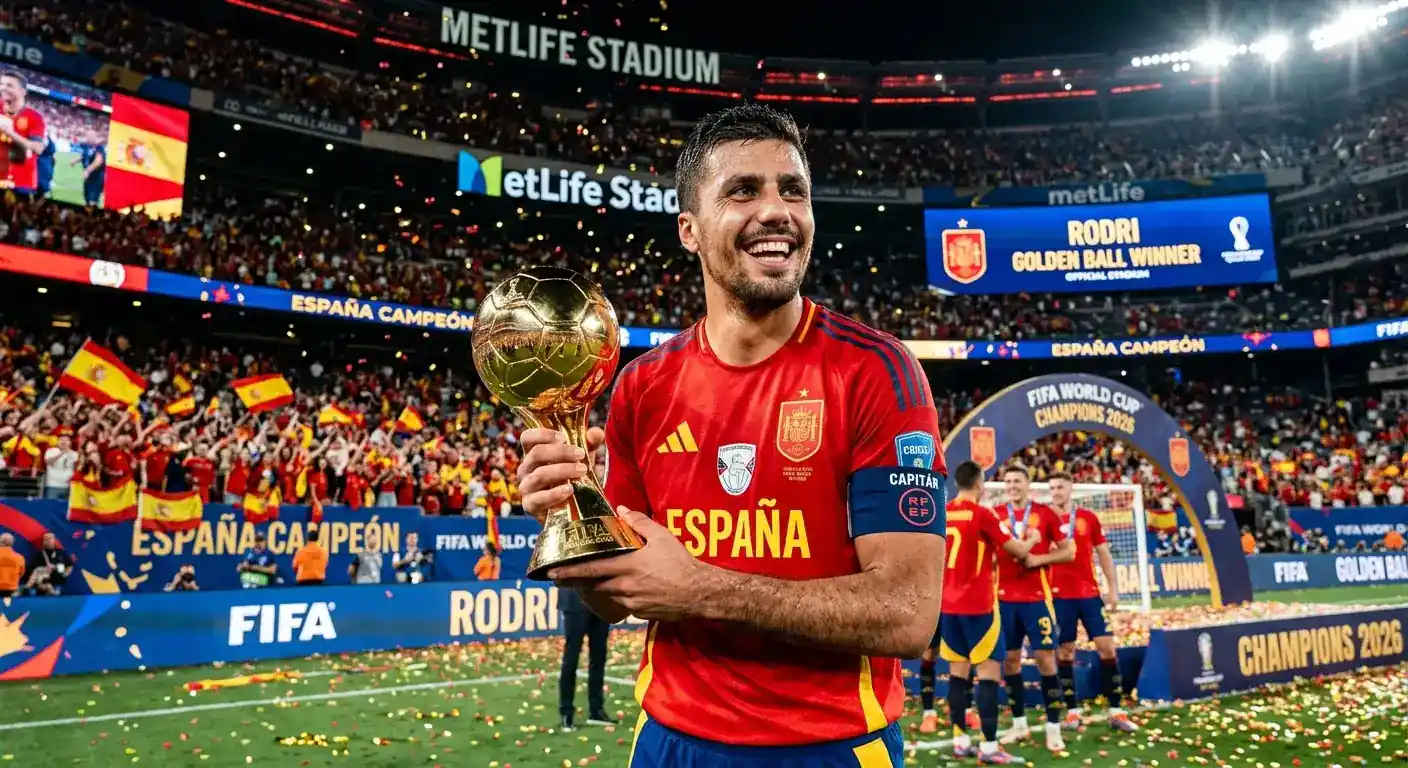
Rodri holds the FIFA Golden Ball trophy after being named the 2026 World Cup’s best player, capping his ACL comeback
Contents
- Golden Ball Result — Rodri Beats Messi
- The Upset — How the Market Got It Wrong
- Rodri’s Tournament Performance
- The ACL Comeback Story
- Records Set by Rodri
- Spain’s Perfect Campaign
- Why Messi Didn’t Win
- Previous Golden Ball Winners
- What Rodri Said
- Betting Markets & Value Analysis
Golden Ball Result — Rodri Beats Messi
Golden Ball Winner: Rodri (Spain)
Silver Ball: Lionel Messi (Argentina)
Bronze Ball: Kylian Mbappé (France)
FIFA announced the individual awards immediately after Spain’s 1-0 victory over Argentina in the final at MetLife Stadium on 19 July 2026. Rodri’s selection as the Golden Ball winner represented the biggest upset among the tournament’s individual honours, with the Spanish midfielder claiming the award ahead of heavily-favoured Lionel Messi.
The 30-year-old Manchester City player captained Spain to a perfect eight wins from eight matches, conceding just one goal throughout the tournament. His performance in the final — controlling the midfield against Argentina despite Spain playing 120 minutes — typified his influence across the campaign.
The Upset — How the Market Got It Wrong
The Golden Ball market heading into the final had Lionel Messi as an overwhelming favourite. The Argentine captain was priced around 1/9 (1.11 decimal) — implying approximately a 90 per cent probability of winning the award. Rodri, by contrast, was available at approximately 10/1 (11.0), suggesting less than a 10 per cent chance.
Pre-final Golden Ball odds (indicative):
- Lionel Messi (ARG): 1/9 (1.11) — did not win
- Kylian Mbappé (FRA): 7/1 (8.0) — Bronze Ball
- Rodri (ESP): 10/1 (11.0) — WON
- Lamine Yamal (ESP): 16/1 (17.0)
- Jude Bellingham (ENG): 25/1 (26.0)
The market’s assumption was that Messi — at 39 and in his likely final World Cup — would crown his career with a second Golden Ball (he won it in 2014 despite Argentina losing the final). His eight goals and four assists heading into the decider reinforced that view. However, three factors combined to upset the market:
- Messi held scoreless in the final — The decisive match passed without a Messi goal or assist, ending 0-0 through ninety minutes before Spain’s 106th-minute winner.
- Argentina lost — FIFA’s Golden Ball has historically favoured players from the winning side. Only twice in modern history (1990, 2014) has a player from the losing finalist won the award.
- Rodri’s all-action final performance — The Spanish captain completed 120 minutes of midfield control, setting the tempo and breaking up Argentine attacks while his team-mates found the decisive goal.
For punters who backed Rodri at 10/1, the return was substantial. A €10 stake would have delivered €110 (€100 profit plus the original €10 stake) on fractional terms, or €110 total return at 11.0 decimal.
Rodri’s Tournament Performance
Rodri started all eight of Spain’s matches, playing the full 120 minutes in the final and anchoring the midfield throughout. His statistics across the tournament underline his dominance:
Passing & Control
- Approximately 756 completed passes across the eight matches — a new single-edition World Cup record, surpassing Xavi’s 599 at the 2010 tournament (also for Spain).
- All-time World Cup career passes: approximately 1,343 — surpassing Dunga’s previous record of 1,306.
- Pass completion rate consistently above 90 per cent, dictating tempo and retaining possession even under pressure.
Defensive Contributions
- Multiple interceptions and tackles per match, breaking up opposition attacks before they developed.
- Positional discipline allowed Spain’s full-backs (Pedro Porro, Marc Cucurella) to push forward without exposing the defence.
- Key role in Spain’s record-breaking defensive performance: just one goal conceded in eight matches.
Leadership
- Captained Spain throughout the knockout rounds after being appointed following the group stage.
- Vocal presence on the pitch, organising the press and maintaining shape during defensive phases.
- Lifted the World Cup trophy at MetLife Stadium, completing the journey from ACL rupture to world champion in less than two years.
Rodri’s performance was not characterised by spectacular individual moments — he scored no goals and provided no assists — but by relentless consistency, positional intelligence and control. His role was to make his team-mates better, and Spain’s eight wins without defeat or draw demonstrate his success.
The ACL Comeback Story
Rodri’s Golden Ball triumph is inseparable from the injury that threatened to derail his career. On 22 September 2024, during a Premier League match for Manchester City against Arsenal, Rodri ruptured his right anterior cruciate ligament (ACL). The injury typically requires nine to twelve months of rehabilitation, and many players struggle to regain their pre-injury level.
Rodri underwent surgery in late September 2024 and missed the remainder of the 2024-25 season. Manchester City manager Pep Guardiola publicly stated in early 2025 that "the real Rodri" would return at the 2026 World Cup — a prediction that proved prescient.
The midfielder returned to training in May 2026, approximately eight months post-surgery, and was declared fit for Spain’s World Cup squad in early June. Initial doubts about his match sharpness were dispelled during the group stage, and by the knockout rounds Rodri had reclaimed his status as Spain’s most important player.
"I’d love for the younger generations to see that a player who touches the heavens, then descends into hell, can come back," Rodri said after winning the Golden Ball. "It’s a lesson in overcoming adversity."
His journey from the operating table in September 2024 to lifting the World Cup trophy in July 2026 — a span of approximately twenty-two months — is one of the defining narratives of the tournament.
Records Set by Rodri
Rodri’s World Cup campaign produced multiple individual records:
Single-Tournament Record
- Most completed passes in a World Cup edition: approximately 756, surpassing Xavi’s 599 (Spain, 2010).
This record is particularly notable given that Spain played eight matches (due to the expanded 48-team format), compared to the seven matches typical in previous editions. However, Rodri’s per-match average (approximately 94.5 passes per game) also exceeded Xavi’s rate, underscoring the midfield dominance.
Career Record
- Most completed passes in World Cup history (career): approximately 1,343, surpassing Dunga’s 1,306.
Rodri’s career total spans the 2022 World Cup (where Spain exited in the round of 16 to Morocco) and the 2026 tournament. His ability to dictate play across two World Cups cements his status among the elite midfielders of his generation.
Unbeaten Record (Team, with Rodri as captain)
Rodri captained Spain through the knockout rounds, during which they extended their unbeaten run to 38 matches — a new outright international record, surpassing Italy’s 37 set between 2018 and 2021. While this is a team record, Rodri’s leadership and midfield control were central to the achievement.
Spain’s Perfect Campaign
Rodri’s Golden Ball cannot be separated from Spain’s collective success. Spain won all eight of their World Cup matches, conceding just one goal (to Belgium’s Youri Tielemans in the quarter-final). Their route to glory:
Group Stage (Group H winners, 7 points):
- Beat Cape Verde 3-0
- Beat Saudi Arabia 2-0
- Beat Uruguay 1-0
Knockout Rounds:
- Round of 32: Beat Austria 3-0
- Round of 16: Beat Portugal 1-0
- Quarter-final: Beat Belgium 2-1
- Semi-final: Beat France 2-0
- Final: Beat Argentina 1-0 (aet)
Spain’s defensive record — one goal conceded in eight matches — is the fewest ever by a World Cup winner. Rodri’s role in shielding the defence, recycling possession and preventing counter-attacks was fundamental to that achievement.
The team also set a new standard for possession dominance. Across the eight matches, Spain averaged approximately 60 per cent possession, with Rodri at the heart of the passing patterns. His ability to evade the press and find progressive passes allowed Spain to control matches even against elite opposition.
Why Messi Didn’t Win
Lionel Messi entered the final as the Golden Ball favourite, and his tournament statistics were extraordinary:
- 8 goals (joint-second in the Golden Boot race)
- 4 assists (extending his all-time World Cup career assists record to 12)
- 33 World Cup appearances (a new record)
- Led Argentina to the final, scoring crucial goals in the semi-final victory over England
However, three factors worked against Messi:
-
Held scoreless in the final — The decisive match ended 0-0 after ninety minutes, with Spain winning 1-0 in extra time. Messi neither scored nor assisted, and Argentina struggled to create attacking opportunities across 120 minutes.
-
Argentina lost — FIFA’s Golden Ball historically favours the winning side. Since the award’s introduction in 1982, only Salvatore Schillaci (1990, Italy third place) and Messi himself (2014, Argentina runners-up) have won it without winning the tournament. Awarding it to a player from the losing finalist is the exception, not the rule.
-
Age and narrative — At 39, Messi’s World Cup story was widely framed as a farewell. While his performances throughout the tournament were exceptional, the Golden Ball ultimately rewarded Rodri’s redemption arc and Spain’s collective triumph.
Messi was named to the Silver Ball, with Kylian Mbappé (10 goals, Bronze Ball) rounding out the podium. For Messi, the Silver Ball represents a bittersweet end to his World Cup career — he extends his record for most World Cup appearances and assists, but the Golden Ball and the trophy both eluded him.
Previous Golden Ball Winners
The Golden Ball has been awarded at every World Cup since 1982. Recent winners:
| Year | Winner | Nation | Tournament Result |
|---|---|---|---|
| 2026 | Rodri | Spain | Champions |
| 2022 | Lionel Messi | Argentina | Champions |
| 2018 | Luka Modrić | Croatia | Runners-up |
| 2014 | Lionel Messi | Argentina | Runners-up |
| 2010 | Diego Forlán | Uruguay | Fourth place |
| 2006 | Zinedine Zidane | France | Runners-up |
Rodri joins an elite group that includes midfielders (Modrić, Zidane), forwards (Messi, Forlán) and players from both winning and losing sides. His 2026 award restores the pattern of the Golden Ball going to the champion — a trend broken in 2018 when Modrić won it despite Croatia’s final defeat to France.
What Rodri Said
Rodri’s post-tournament quotes reflect both humility and pride in his journey:
On winning the Golden Ball:
"It feels like the perfect script. I certainly didn’t expect this. We’re on cloud nine. This squad is sensational. We’re two-time World Cup champions. It was the toughest tournament in World Cup history. We beat a great Argentina side, featuring Messi, the best player in history."
On his ACL comeback:
"I’d love for the younger generations to see that a player who touches the heavens, then descends into hell, can come back. It’s a lesson in overcoming adversity."
On Spain’s achievement:
"We’re on cloud nine. This squad is sensational. We’re two-time World Cup champions."
Rodri’s emphasis on the collective — "this squad is sensational" — is characteristic of his approach. Despite winning the individual award, his focus remained on Spain’s team achievement: the World Cup title, the Euro 2024–World Cup 2026 double, and the unprecedented feat of holding the men’s and women’s World Cups simultaneously.
Betting Markets & Value Analysis
The Golden Ball market offers valuable lessons for long-term tournament betting. Here’s how the 2026 market evolved and where value appeared:
Pre-Tournament Favourites (Early June 2026)
Before the tournament began, the Golden Ball market was led by:
- Kylian Mbappé (France): approximately 6/1
- Erling Haaland (Norway): approximately 8/1
- Jude Bellingham (England): approximately 10/1
- Lionel Messi (Argentina): approximately 12/1
- Lamine Yamal (Spain): approximately 14/1
Rodri was not among the pre-tournament favourites, typically priced around 25/1 or longer. His odds shortened as Spain progressed, but he remained a longshot until the final.
Pre-Final Market (18 July 2026)
By the eve of the final, the market had consolidated around:
- Lionel Messi: 1/9 (overwhelming favourite)
- Kylian Mbappé: 7/1 (already confirmed Golden Boot winner)
- Rodri: 10/1
- Lamine Yamal: 16/1
Where Was the Value?
In hindsight, Rodri at 10/1 represented significant value. Three factors made his price too long:
- Spain were marginal favourites to win the final (approximately 4/6), and the Golden Ball historically favours the winning side.
- Rodri’s consistent performances across seven matches had established him as Spain’s key player, yet the market remained fixated on Messi.
- The narrative arc — ACL comeback, captain, midfield dominance — was compelling and likely to sway FIFA’s voting panel if Spain won.
A more accurate pre-final price for Rodri might have been around 5/1 or 6/1, making the 10/1 available a value bet. However, identifying this value required looking beyond the obvious (Messi’s goal tally) and assessing the likely voting behaviour if Spain won the final.
Lessons for Future Tournaments
- The Golden Ball favours winners — Since 1982, players from the champion team have won the award in 8 of 12 tournaments.
- Narrative matters — FIFA’s voting panel responds to compelling stories (Modrić’s 2018 win, Rodri’s 2026 comeback).
- Late-stage odds can overreact to goal tallies — Messi’s 1/9 price reflected his scoring record but underestimated the importance of the final result.
Where to Bet on 2030 World Cup Golden Ball
The 2030 World Cup will be held across Spain, Portugal, Morocco, Uruguay, Argentina and Paraguay, with early outright and individual-award markets already available at leading bookmakers.
Irish punters can access these markets through licensed operators including Boomerang Bet.com, BetiBet, Blitz.bet, ZotaBet, Spinstar.bet, BillyBets, MrPacho, LamaBet, WinRolla and RichRoyal. All accept EUR and offer fractional and decimal odds formats.
When betting on individual awards such as the Golden Ball, consider:
- Team success matters — Back players from teams likely to reach the final.
- Position flexibility — Midfielders and forwards dominate the award; defenders rarely win.
- Narrative appeal — Compelling personal stories (redemption, breakthrough, farewell) influence voting.
- Rodri won the 2026 World Cup Golden Ball at 10/1, upsetting favourite Messi (1/9)
- Completed ACL comeback — ruptured ligament Sept 2024, world champion July 2026
- Set single-edition passing record (756 completed) and career record (1,343)
- Captained Spain to perfect 8-0 record, conceding just 1 goal
- Messi held scoreless in final, finished with Silver Ball
- Golden Ball has gone to the winning side in 9 of 13 tournaments since 1982
Last updated: 20 July 2026 | Odds from multiple bookmakers, 18–19 July 2026
