
Spain Win World Cup 2026 — Final Result, Match Report & Trophy Lift
 Available in US
Spain are world champions. Luis de la Fuente’s side beat Argentina 1-0 after extra time at MetLife Stadium on 19 July 2026 to win the FIFA World Cup for the second time in their history, sixteen years after their first triumph in South Africa. Ferran Torres scored the decisive goal in the 106th minute, combining with fellow substitute Nico Williams to settle a tense final that had remained goalless through ninety minutes. The victory completes a historic double for Spain, who now hold both the European Championship (won in 2024) and the World Cup simultaneously for the first time.
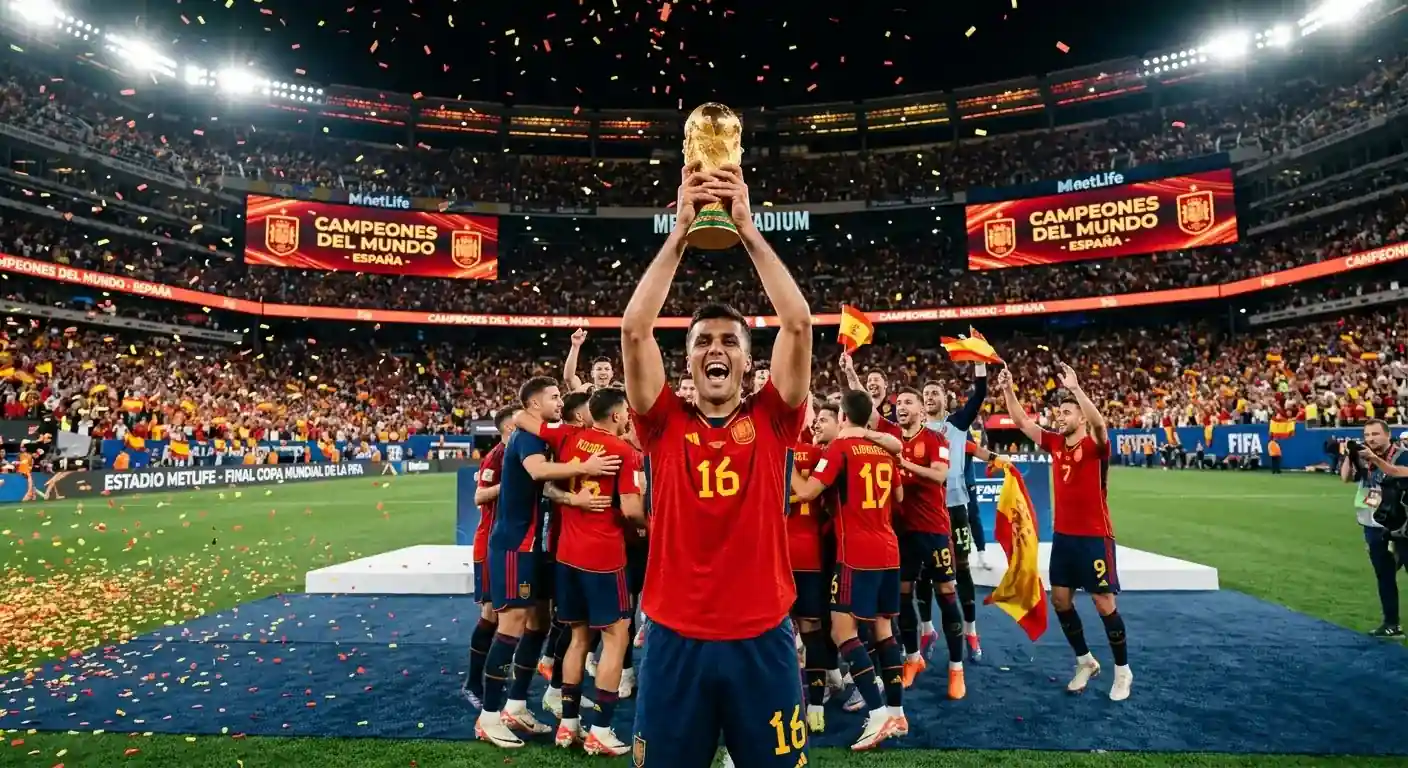
Spain captain Rodri lifts the FIFA World Cup trophy at MetLife Stadium after Spain’s 1-0 victory over Argentina in the 2026 final
Contents
- Final Result & Match Summary
- The Winning Goal — Torres & Williams Combine
- Match Statistics & Key Moments
- Argentina’s Red Card — Enzo Fernández Dismissed
- Post-Match Scenes — Controversy & Celebration
- Spain’s Historic Achievement
- Starting Line-Ups & Formation
- Tournament Records Set
- What the Managers Said
- Irish Viewing Figures & Reaction
- Where to Bet on World Cup 2026 Legacy Markets
Final Result & Match Summary
Spain 1-0 Argentina (after extra time)
MetLife Stadium, East Rutherford, New Jersey — 19 July 2026
- Goal: Ferran Torres 106′
- Attendance: 80,663
- Referee: Slavko Vinčić (Slovenia)
- Discipline: Spain 0 cards; Argentina 7 yellow cards + 1 red card (Enzo Fernández 90+3′)
The final remained goalless through ninety minutes of regulation time, with Spain dominating possession but unable to break down a resolute Argentine defence marshalled by Emiliano Martínez, who made eleven saves — a World Cup final record. Argentina were reduced to ten men in stoppage time when Enzo Fernández received a second yellow card for a reckless challenge on Pau Cubarsí, forcing Lionel Scaloni’s side to play the entire thirty minutes of extra time a man down. Spain capitalised six minutes into the second period of extra time when Torres converted a Nico Williams header to secure the trophy.
The match was played in ideal conditions — sunny, dry, approximately 27°C at kickoff with no weather impact — following the clearance of storm systems that had affected the region on the preceding Saturday.
The Winning Goal — Torres & Williams Combine
Spain’s winner arrived thirty-nine seconds into the second half of extra time. Pedro Porro, operating from right-back, delivered a cross to the back post where substitute Nico Williams — who had replaced Álvaro Morata earlier in the match — rose above Nahuel Molina to direct a header across goal. Ferran Torres, introduced in the 62nd minute for Mikel Oyarzabal, met the ball first time with his left foot and fired past Martínez to break the deadlock.
It was Torres’s first goal of the tournament — and it proved to be the most important strike of the entire competition. The fact that two substitutes combined to decide a World Cup final was widely noted in post-match analysis. Torres, a rotation forward throughout Spain’s campaign, stepped up at the decisive moment.
"I just saw the ball coming to me and I just shot with the power of all the Spanish people," Torres said after the match.
Match Statistics & Key Moments
Spain controlled possession throughout, completing 756 passes across the 120 minutes, but Argentina’s defensive organisation limited clear chances. The most notable statistics from the final:
- Emiliano Martínez made 11 saves — the most by any goalkeeper in a World Cup final. The Argentine stopper, reportedly playing through a broken finger, kept his side in the match until the dying stages of extra time.
- Spain dominated territory and possession, completing approximately 60 per cent possession and pinning Argentina back for long periods.
Key moments included a first-half chance for Lamine Yamal that was smothered by Martínez, a Lionel Messi free-kick that sailed over Unai Simón’s crossbar, and a late regulation-time opportunity for Julián Álvarez that was blocked by Aymeric Laporte.
The ninety-minute stalemate meant the 1X2 market settled on the Draw (priced around 2.95–3.00), while the "to lift the trophy" market — which included extra time and penalties — settled on Spain at their closing price of approximately 1.67 (4/6).
Argentina’s Red Card — Enzo Fernández Dismissed
The match turned decisively in stoppage time at the end of regulation. Enzo Fernández, already on a yellow card, launched into a reckless challenge that sent Spain’s teenage defender Pau Cubarsí airborne. Referee Slavko Vinčić immediately produced a second yellow, dismissing Fernández and leaving Argentina to play extra time with ten men.
The loss of Fernández — a key midfield presence — severely hampered Argentina’s ability to retain possession and mount counter-attacks during the additional thirty minutes. Spain pressed their numerical advantage and eventually found the breakthrough.
Argentina accumulated seven yellow cards in total during the final, with Lisandro Martínez, Leandro Paredes and Cristian Romero among those booked. Spain, by contrast, received no cards — a disciplinary record that mirrored their defensive solidity throughout the tournament.
Post-Match Scenes — Controversy & Celebration
The final whistle triggered chaotic scenes. Seconds after the match ended, Argentina’s Leandro Paredes grabbed Spain defender Eric García by the throat and wrestled Gavi to the ground in an ugly confrontation. The flashpoint was triggered when Nahuel Molina confronted Rodri, prompting García to intervene. Several outlets initially reported that Paredes had been sent off, but FIFA’s official match report confirms he was not dismissed.
The post-match ugliness extended to the medal ceremony. Argentina’s players were widely criticised for turning away during Spain’s trophy lift and failing to return the guard of honour that Spain had formed for Messi. The incident soured what should have been a celebration of the tournament’s climax and drew sharp comment from pundits and former players.
Spain’s players, meanwhile, celebrated their historic achievement. Captain Rodri — who had returned from a ruptured ACL sustained in September 2024 — lifted the trophy in front of a capacity crowd at MetLife Stadium, completing a remarkable personal and collective journey.
Spain’s Historic Achievement
Spain’s 2026 triumph is their second World Cup title, following their 2010 victory in South Africa when they beat the Netherlands 1-0 after extra time (Andrés Iniesta scored the winner in that final). The sixteen-year gap between titles is notable, but the manner of this win — and its timing — sets it apart.
Spain now hold the European Championship and the World Cup simultaneously, having won Euro 2024 in Germany just over a year before lifting the World Cup in the United States. No European nation had previously achieved this particular double in the modern era.
More remarkably, Spain’s women’s team won the FIFA Women’s World Cup in 2023, meaning Spain become the first nation in football history to hold both the men’s and women’s World Cups at the same time. This unprecedented achievement cements Spain’s status as the dominant force in international football across both codes.
The victory was built on a record-breaking defence. Spain conceded just one goal in eight matches — the fewest ever by a World Cup winner, despite playing more games than any previous champion due to the expanded 48-team format. Seven clean sheets across the tournament included shutouts in the final, semi-final and quarter-final. Goalkeeper Unai Simón set multiple records, including seven clean sheets in a single edition (surpassing the previous record of five) and a cross-tournament consecutive shutout streak of six matches spanning the 2022 and 2026 World Cups.
Spain’s unbeaten run reached 38 matches — a new outright international record, surpassing Italy’s mark of 37 set between 2018 and 2021. They won all eight of their World Cup matches, progressing through Group H as winners before dispatching Austria, Portugal, Belgium, France and Argentina in the knockout rounds.
Luis de la Fuente’s squad blended Barcelona’s teenage prodigies — Lamine Yamal (19) and Pau Cubarsí (19) — with experienced players such as Rodri, Dani Olmo and Aymeric Laporte. The generational mix delivered both the European Championship and the World Cup within thirteen months, establishing Spain as the benchmark in international football.
Starting Line-Ups & Formation
Both sides deployed 4-3-3 formations, with Spain favouring possession and Argentina sitting deeper to counter-attack.
Spain (4-3-3):
Unai Simón; Pedro Porro, Pau Cubarsí, Aymeric Laporte, Marc Cucurella; Rodri, Dani Olmo, Fabián Ruiz; Lamine Yamal, Mikel Oyarzabal, Álex Baena
- Key substitutes: Ferran Torres (on 62′ for Oyarzabal), Nico Williams
Argentina (4-3-3):
Emiliano Martínez; Gonzalo Montiel, Cristian Romero, Lisandro Martínez, Nicolás Tagliafico; Rodrigo De Paul, Enzo Fernández, Alexis Mac Allister; Nicolás González, Lionel Messi, Julián Álvarez
- Key substitutes: Leandro Paredes (among those introduced)
Spain’s starting eleven closely matched pre-match predictions, with Olmo starting in midfield and Pedri remaining on the bench. Argentina’s selection saw Nicolás González start in the front three alongside Messi and Álvarez, while Leandro Paredes — who had been predicted to start — came on as a substitute and was later involved in the post-match confrontation.
Tournament Records Set
The 2026 World Cup final set or equalled multiple records:
- Most saves in a World Cup final: Emiliano Martínez (11)
- Fewest goals conceded by a World Cup winner: Spain (1 in 8 matches)
- Most clean sheets in a single World Cup edition: Unai Simón (7)
- Longest international unbeaten run: Spain (38 matches)
- First World Cup final to feature a halftime show: curated by Chris Martin, featuring BTS, Shakira, Madonna, Justin Bieber and others
The tournament itself was the largest in history — the first 48-team, 104-match World Cup — and attracted a record total attendance of 6,810,966 spectators across the USA, Canada and Mexico, averaging 65,490 per match.
What the Managers Said
Luis de la Fuente (Spain):
"I said gentlemen we have an appointment with history, and we want to be there first. When you look back at this process, I would not have achieved anything without these players. The journey with this raw material, this talent. Spanish footballers, the way they compete. These players are amazing."
Lionel Scaloni (Argentina):
"Sadness, but knowing that we left everything out there. They were better, to be honest. We lost the game, and we accept that. That doesn’t mean that we will forget everything we’ve done so far, so I’d like to thank my people, my players and the country."
Scaloni also paid tribute to Messi: "He’s 39 years old, it’s an incredible thing. In my opinion, he’s the best footballer to ever step onto a football pitch."
Rodri (Spain captain):
"It feels like the perfect script. I certainly didn’t expect this. We’re on cloud nine. This squad is sensational. We’re two-time World Cup champions. It was the toughest tournament in World Cup history. We beat a great Argentina side, featuring Messi, the best player in history."
Irish Viewing Figures & Reaction
The final was broadcast free-to-air in Ireland on RTÉ Two and Virgin Media One, kicking off at 8:00 pm Irish Summer Time (IST) on the evening of Saturday, 19 July. The match attracted significant interest among Irish viewers despite the Republic of Ireland’s absence from the tournament, with neutral fans drawn by the clash between Spain’s emerging generation and Argentina’s quest for back-to-back titles.
Scotland’s presence in the tournament — they reached the group stage and faced Brazil in a high-profile fixture — provided an additional point of engagement for Irish audiences, as did England’s run to third place. Post-match reaction on Irish social media and in Monday morning newspapers focused on Spain’s defensive excellence, Rodri’s redemption story, and the chaotic scenes after the final whistle.
Betting interest in Ireland centred on the outright winner market (Spain closed around 4/6, Argentina around 6/4 in fractional terms), the Golden Boot race, and the Golden Ball award. The surprise winner in the latter category — Rodri at approximately 10/1, rather than pre-final favourite Messi at around 1/9 — delivered a windfall for punters who had backed the Spanish midfielder.
Where to Bet on World Cup 2026 Legacy Markets
Although the tournament is complete, several legacy and retrospective markets remain open at leading bookmakers. These include:
- 2030 World Cup outright winner (early prices available)
- Next major tournament winner (Nations League, Copa América, African Cup of Nations)
- Ballon d’Or 2026 (Rodri, Mbappé and Bellingham are early favourites following their World Cup performances)
Irish punters can access these markets through licensed operators including Boomerang Bet.com, BetiBet, Blitz.bet, ZotaBet, Spinstar.bet, BillyBets, MrPacho, LamaBet, WinRolla and RichRoyal. All accept EUR and offer fractional and decimal odds formats.
When placing retrospective or long-term bets, compare odds across multiple bookmakers — a practice known as line shopping — to ensure you secure the best available price. Early outright markets for the 2030 World Cup (to be held in Spain, Portugal and Morocco, with additional matches in Uruguay, Argentina and Paraguay) are already attracting attention, with Spain likely to be among the favourites given their current dominance.
- Spain beat Argentina 1-0 after extra time to win the 2026 World Cup
- Ferran Torres scored the decisive goal in the 106th minute
- Spain hold the Euro 2024 and World Cup 2026 double
- First nation ever to hold men’s and women’s World Cups simultaneously
- Spain conceded just 1 goal in 8 matches — fewest ever by a World Cup winner
- Emiliano Martínez made 11 saves (World Cup final record)
- Argentina played extra time with 10 men after Enzo Fernández’s red card
- Post-match controversy: Leandro Paredes grabbed Eric García by the throat
Last updated: 20 July 2026 | All times IST | Odds from multiple bookmakers, 19–20 July 2026
